You’re chopping cauliflower for dinner when a florets drops to the floor. Before you can react, your dog has already swallowed it. Now you’re standing there wondering: can dogs eat cauliflower, or did you just create a problem? Take a breath — this is one of the more forgiving kitchen accidents.
Quick Answer
Yes, dogs can eat cauliflower safely in small amounts. It’s non-toxic, low in calories, and offers fiber, vitamin C, and vitamin K. Plain cooked cauliflower works best, served without butter, salt, garlic, or oil. This guide helps owners who want to share vegetables without upsetting their dog’s stomach.
TL;DR
Cauliflower is safe but gassy. Keep portions under 10% of daily calories, cook it plain, and cut it into small pieces to prevent choking. Skip it entirely if your dog has a sensitive digestive system or a history of bloat.
Key Takeaways
- Cauliflower is non-toxic to dogs and contains fiber, vitamin C, vitamin K, and folate.
- Cooked and unseasoned is safer than raw, since heat softens the tough cell walls.
- Small dogs should get one to two small florets; large dogs can handle a small handful.
- Excess cauliflower causes gas, bloating, and loose stools in many dogs.
- Never serve cauliflower cooked with garlic, onion, butter, or heavy salt.
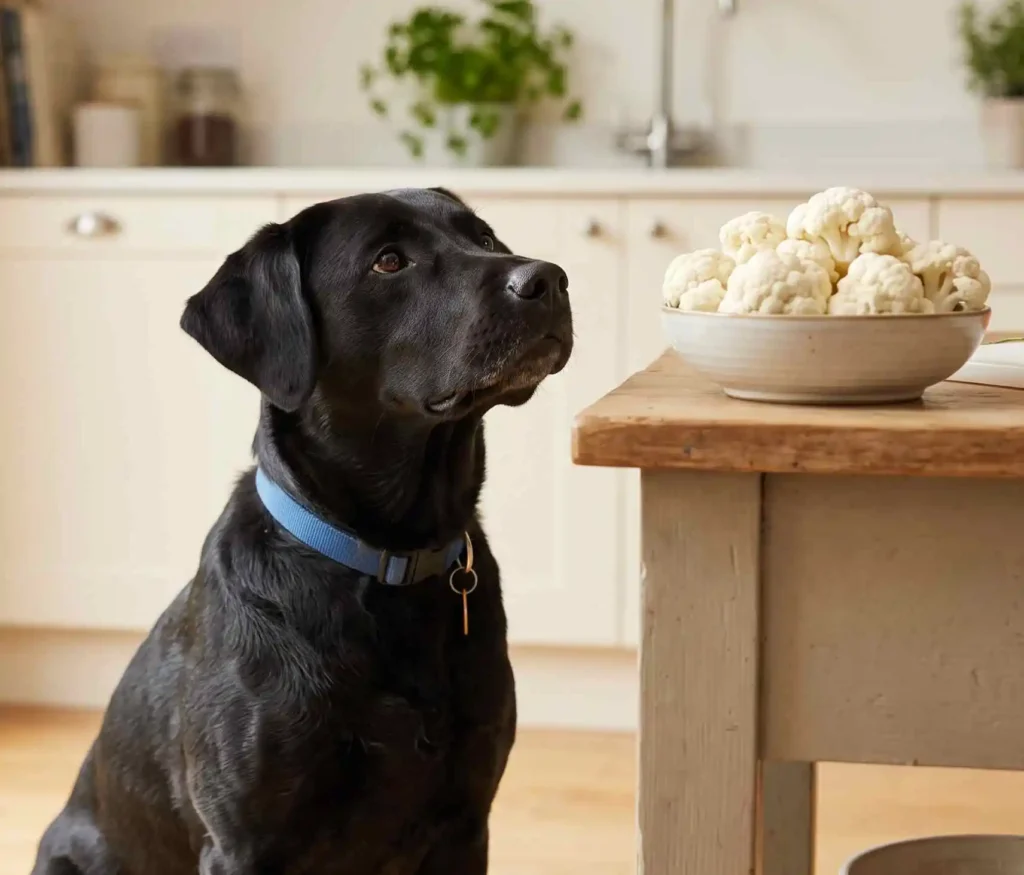
Table of Contents
Why This Matters for Your Dog
Vegetables feel like a harmless treat. Most owners assume anything healthy for humans must be healthy for dogs too. That assumption causes more vet visits than you’d expect.
Cauliflower belongs to the brassica family, alongside broccoli, cabbage, and Brussels sprouts. These vegetables contain compounds that ferment heavily in the gut. In humans, that means mild discomfort. In a 12-pound dog with a much shorter digestive tract, the same amount causes real distress.
The risk isn’t poisoning. It’s volume. A dog who eats half a head of cauliflower will likely spend the night pacing, passing gas, and possibly vomiting. Deep-chested breeds like Great Danes and Standard Poodles face an additional concern, since gas buildup is one contributing factor in bloat.
There’s also the choking angle. Raw cauliflower stems are dense and slippery. A dog who gulps rather than chews can lodge a chunk in the throat. If your dog inhales food rather than eating it, a slow feeder dog bowl changes the mechanics of every meal, not just vegetable snacks.
None of this makes cauliflower dangerous. It makes portion control mandatory.
What’s Actually Inside Cauliflower
Cauliflower is roughly 92% water. That’s why it fills a dog up without adding many calories. One cup of raw florets contains about 27 calories.
The nutrients worth noting:
Vitamin C supports immune function. Dogs produce their own vitamin C, so this is a bonus rather than a requirement.
Vitamin K helps blood clot properly and supports bone metabolism.
Fiber feeds beneficial gut bacteria and adds bulk to stool. This is also the source of the gas problem when portions get too large.
Folate and potassium appear in modest amounts and support cell function and nerve signaling.
Sulforaphane and isothiocyanates are the sulfur compounds that give brassicas their smell. These have been studied for antioxidant properties, but they’re also what ferments in the colon and produces gas.
Here’s the honest framing: cauliflower is not a nutritional necessity. A dog eating a complete, balanced commercial diet already gets everything on this list. Cauliflower is a low-calorie snack option, not a supplement. If you’re focused on nutrient density, the range of superfoods for dogs offers better returns per bite.
Raw Versus Cooked
Cooking breaks down the tough cellulose walls in cauliflower. That makes it easier to digest and slightly reduces gas production. Steaming preserves more nutrients than boiling.
Raw cauliflower isn’t dangerous, but it’s harder on the stomach and poses more of a choking risk. If you serve it raw, chop it finely.
Common Mistakes and How to Fix Them
Mistake 1: Serving cauliflower cooked with the family dinner. Garlic and onion are toxic to dogs, and both show up constantly in roasted cauliflower recipes. Butter and oil add fat that can trigger pancreatitis in sensitive dogs. The fix: Set aside a plain portion before adding anything else to the pan.
Mistake 2: Treating it as a meal replacement. Some owners load the bowl with vegetables to help a dog lose weight. This dilutes the balanced nutrition in their regular food. The fix: Keep all treats, including vegetables, under 10% of daily calories.
Mistake 3: Ignoring the first reaction. A dog who gets gassy after one floret will get worse after five. The fix: Introduce one small piece, then wait 24 hours before offering more.
Mistake 4: Serving large chunks. Whole florets and thick stem pieces are choking hazards, particularly for small breeds and fast eaters. The fix: Cut everything into bite-sized pieces, roughly the size of your dog’s kibble.
Mistake 5: Giving cauliflower to a dog with existing digestive issues. If your dog already deals with intermittent loose stools, adding fermentable fiber makes things worse. The fix: Resolve the underlying issue first. Persistent dog diarrhea needs attention before you experiment with new foods.
Mistake 6: Using frozen cauliflower straight from the bag. Frozen florets are rock hard and can crack teeth. The fix: Thaw and cook, or offer only fully softened pieces.
Mistake 7: Assuming cauliflower rice is the same thing. Prepared cauliflower rice products often contain seasoning, oil, or added ingredients. The fix: Read the label. Plain riced cauliflower with no additives is fine in small amounts.
When Gas Becomes a Bigger Conversation
Most cauliflower-related gas resolves within a day. But if your dog is chronically gassy — cauliflower or not — the root cause is usually eating speed or gut bacteria balance, not the vegetable itself.
Dogs who swallow air along with their food produce dramatically more gas. This happens most in dogs who finish a bowl in under a minute. Slowing the pace mechanically is the simplest fix available.
The Outward Hound Fun Feeder Slo Bowl uses a raised spiral pattern that forces a dog to work around ridges instead of scooping food in one motion. It’s built for medium to large dogs with a four-cup capacity, and the non-slip base keeps determined eaters from shoving it across the floor. In practice, most dogs go from a 45-second meal to somewhere around four or five minutes, which cuts air swallowing significantly. The honest limitation: the grooves collect residue with wet food, so it needs proper washing rather than a quick rinse.
CHECK PRICE ON AMAZON: https://amzn.to/40buzas
Gut bacteria balance matters too. When the microbiome tilts toward gas-producing species, every fermentable food — cauliflower included — creates more of a reaction than it should.
Purina Pro Plan Veterinary Supplements FortiFlora is a probiotic powder that comes in single-serve packets you sprinkle over food. It’s intended for dogs with loose stools or digestive upset, and the liver flavoring means most dogs eat it without noticing. It’s a reasonable option if you’re introducing new foods and want to support the gut through the transition. Worth being upfront: it’s noticeably more expensive per serving than bulk probiotic tubs, and results typically take a week or more to show.
CHECK PRICE ON AMAZON: https://amzn.to/3ZySvV4
Neither product makes cauliflower risk-free. They address the underlying conditions that make gas worse.
How to Serve Cauliflower Safely
- Choose fresh, firm cauliflower. Avoid heads with brown spots or a strong smell.
- Wash thoroughly. Rinse under cold water to remove pesticide residue and dirt trapped between florets.
- Trim off the leaves and thick core. These are the toughest parts and the hardest to digest.
- Cut into small pieces. Aim for pieces no larger than your dog’s regular kibble.
- Steam for five to seven minutes. The cauliflower should be fork-tender but not mushy. Skip the salt, butter, and oil entirely.
- Let it cool completely. Hot food can burn a dog’s mouth, and dogs rarely pace themselves.
- Start with one piece. Offer a single small floret and watch for the next 24 hours.
- Scale up gradually if all goes well. Small dogs (under 20 lbs) top out at one to two small florets. Medium dogs handle three to four. Large dogs can manage a small handful.
- Cap the frequency. Two or three times per week is plenty. Daily cauliflower is unnecessary and increases the gas load.
Cauliflower also works well mashed into a lick mat or frozen into a puzzle toy for enrichment. If mental stimulation is the goal, pairing food with interactive dog toys extends the experience well beyond a two-second snack.
Troubleshooting
If your dog gets gassy after one small piece → cauliflower isn’t a good fit for them. Try carrots or cucumbers instead, which ferment far less.
If stool becomes loose within 12 hours → skip vegetables for 48 hours and return to their regular food only.
If your dog ate a large amount unsupervised → monitor for a restless posture, a hard belly, or unproductive retching. These signal a possible emergency.
If your dog refuses cauliflower → don’t push it. There’s no nutritional gap being left unfilled.
If your dog vomits once and seems fine afterward → withhold food for a few hours, then offer a small bland meal. Repeated vomiting needs a vet.
If your dog is on a prescription diet → check with your vet before adding anything, including vegetables.
If your dog has a history of bladder stones → ask your vet specifically. Some stone types require careful management of mineral intake.
When to Call Your Veterinarian
Contact your vet promptly if you notice:
- A distended, firm abdomen paired with restlessness or attempts to vomit without producing anything
- Repeated vomiting over several hours
- Diarrhea lasting more than 24 hours, or containing blood
- Visible abdominal pain, such as a hunched posture or refusing to lie down
- Lethargy or refusal to drink water
- Any sign of choking, including gagging, pawing at the mouth, or difficulty breathing
The bloat concern deserves particular attention. Gastric dilatation-volvulus is a genuine emergency that progresses within hours. It’s not caused by cauliflower directly, but gas accumulation is part of the picture in at-risk breeds.
What the Guidance Says
The American Kennel Club lists cauliflower among vegetables that are safe for dogs when served plain and in moderation, noting the fiber and vitamin content alongside the gas caveat. You can review their broader guidance on fruits and vegetables dogs can eat.
Veterinarians generally follow the ten percent rule for treats: anything outside a dog’s complete and balanced diet should stay under a tenth of daily calories. The American Veterinary Medical Association maintains resources on pet nutrition and food safety that reinforce the same principle — commercial diets are formulated to be complete, and additions should supplement rather than displace them.
The practical takeaway from both: cauliflower is fine as an occasional snack, and it’s not doing anything for your dog that their regular food isn’t already doing better.
This article provides general information and does not replace a veterinary diagnosis. Your vet knows your dog’s history, weight, and medical conditions in a way no article can.
Frequently Asked Questions
Can dogs eat raw cauliflower? Yes, but cooked is easier to digest. Raw cauliflower is tougher on the stomach and poses more of a choking risk. If serving raw, chop it into very small pieces.
How much cauliflower can a dog eat? Small dogs: one to two small florets. Medium dogs: three to four. Large dogs: a small handful. Keep total treats under 10% of daily calories.
Can puppies eat cauliflower? In tiny amounts, yes, but it’s better to wait. Puppy digestive systems are still developing, and their nutritional needs are met by puppy food. Introduce vegetables after six months.
Does cauliflower give dogs gas? Frequently, yes. Cauliflower contains fermentable fibers and sulfur compounds that produce gas in the colon. Smaller portions and cooking both reduce the effect.
Can dogs eat cauliflower leaves and stems? The leaves are safe but tough. The thick core is dense and harder to digest. Stick to the florets and tender stem sections.
Is cauliflower rice safe for dogs? Plain riced cauliflower with no added ingredients is safe in small amounts. Many packaged versions include seasoning or oil, so check the label first.
Can dogs eat cauliflower cheese? No. The cheese sauce adds fat, dairy, and often garlic or onion powder. Serve plain cauliflower only.
Is frozen cauliflower okay for dogs? Thaw and cook it first. Frozen florets are hard enough to damage teeth, and dogs tend to bite down without testing.
Can dogs with sensitive stomachs eat cauliflower? It’s best avoided. Fermentable fiber makes existing digestive issues worse. Lower-fiber options like cucumber or plain cooked pumpkin are gentler.
What vegetables are better than cauliflower for dogs? Carrots, green beans, cucumber, and plain pumpkin all cause less gas. Broccoli sits in the same brassica family and carries similar caveats.
The Bottom Line
So, can dogs eat cauliflower? Yes — plain, cooked, cut small, and offered in modest amounts. It’s non-toxic, low in calories, and adds a bit of fiber and vitamin C to a snack rotation. The real risk isn’t toxicity but volume, since brassica vegetables ferment heavily and produce uncomfortable gas. Start with a single floret, watch how your dog responds over the next day, and scale from there. If your dog gets gassy or loose-stooled, take the hint and switch to carrots or cucumber instead. Your next step is simple: the next time you’re prepping cauliflower, set aside one plain floret before the seasoning goes in, steam it, and let your dog tell you whether this one’s a keeper.