It’s midnight, and you’re watching your eight-week-old snooze in her crate. Her tiny ribs are pumping like she just ran a marathon. Your stomach drops. Seeing a puppy breathing fast while sleeping scares nearly every new owner, and most of the time the explanation is completely harmless.
Quick Answer
A puppy breathing fast while sleeping is usually normal, especially during dream-heavy REM sleep. Healthy resting puppies breathe roughly 15 to 40 breaths per minute, and short bursts above that are common in young pups. It becomes a concern when fast breathing is constant, comes with gum color changes, or continues in deep, still sleep.
TL;DR: Brief episodes of rapid, shallow breathing during dreaming are normal puppy behavior. Sustained rates over 40 breaths per minute in calm, deep sleep — especially with blue gums, effortful belly breathing, or coughing — need a same-day vet call.
Key Takeaways
- Count breaths for 30 seconds while your pup is in deep, still sleep, then double the number.
- Under 40 breaths per minute at rest is the general benchmark for puppies.
- Twitching paws, soft whimpers, and irregular breathing usually mean dreaming, not distress.
- Pale, blue, or grey gums are an emergency — go straight to a vet.
- Heat, excitement before bed, and a full stomach all temporarily raise breathing rate.
This article shares general educational information. It is not a substitute for a veterinary diagnosis.
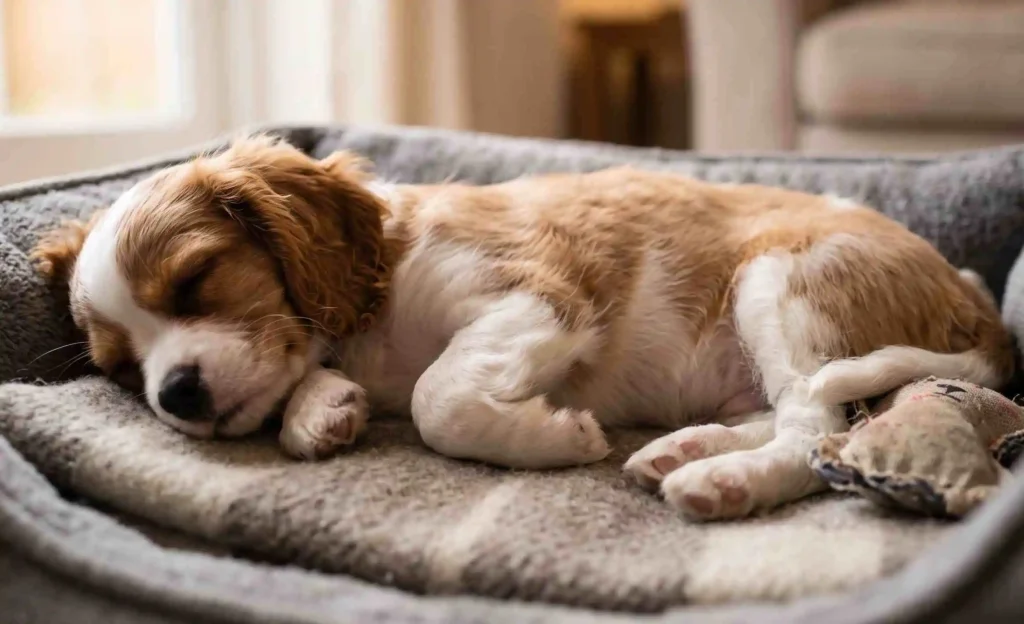
Table of Contents
Why Puppy Breathing Rate Matters
Breathing is one of the clearest windows into a dog’s health. Lungs, heart, temperature control, and pain all show up in how a puppy breathes. That’s why vets check respiratory rate at every single visit.
Puppies also have less reserve than adult dogs. Their airways are narrow, their chests are small, and problems escalate faster. Catching a genuine breathing change early gives your vet far more options.
None of this means you should panic. The vast majority of fast sleep breathing in puppies resolves on its own within minutes. The goal is simply to know the difference between a dreaming pup and a struggling one.
How Puppy Breathing Actually Works
Air enters the nose, travels down the trachea, and reaches millions of tiny air sacs in the lungs. Oxygen crosses into the blood there, and carbon dioxide moves out. The diaphragm — a sheet of muscle under the lungs — does most of the pulling.
Puppies have a higher metabolic rate than adult dogs. They’re building bone, muscle, and brain tissue at an astonishing pace. All that construction burns oxygen, so their baseline breathing sits faster than a grown dog’s.
The REM Sleep Explanation
Here’s the part most owners never hear. Dogs cycle through sleep stages just like people do, and puppies spend far more time in REM sleep than adults. During REM, the brain is highly active. Breathing becomes fast, shallow, and irregular.
You’ll often see paws paddling, ears flicking, or a muffled bark alongside the rapid breaths. That combination is the classic dreaming signature. My neighbour once called an emergency line at 2 a.m. over her Beagle pup — who woke up mid-call, stretched, and went back to sleep breathing normally.
What “Normal” Looks Like in Numbers
Resting adult dogs generally breathe 10 to 30 times per minute. Puppies commonly run 15 to 40. During REM bursts, brief spikes above 40 are not unusual and settle within a few minutes.
The critical word is resting. A rate measured five minutes after a play session tells you nothing useful. Wait until your pup is deeply asleep and still.
Common Mistakes (and Fixes)
- Counting during dream sleep. Twitching, whimpering pups give falsely high numbers. The fix: wait for the still, deep phase of sleep before counting.
- Panicking over a single episode. One fast spell means very little on its own. The fix: track the pattern over several nights before drawing conclusions.
- Ignoring room temperature. Overheated puppies breathe faster to cool down. The fix: keep the sleeping area between 68 and 75°F and away from radiators.
- Confusing panting with fast breathing. Open-mouth panting is thermoregulation; closed-mouth rapid breathing is different. The fix: note whether the mouth is open or closed.
- Skipping the gum check. Colour is the fastest oxygen indicator you have. The fix: lift the lip and look for healthy bubblegum pink.
- Feeding a huge meal right before bed. A full stomach presses against the diaphragm. The fix: finish dinner at least 90 minutes before sleep.
- Waiting too long with brachycephalic breeds. Flat-faced pups have far less airway margin. The fix: call your vet sooner rather than later with these breeds.
Practical Tools That Help You Monitor at Home
Once you’ve watched a few nights, you’ll notice how much easier this gets with the right setup. Two situations come up constantly with worried owners: not being able to rule out fever, and a puppy who simply can’t settle enough to sleep calmly in the first place.
When You Need to Rule Out Fever
Fast breathing plus a raised temperature points somewhere very different than fast breathing alone. Guessing by touching ears or a nose is genuinely unreliable — vets say this every day. A real reading gives your vet actual data when you call.
The iProven Dog & Cat Thermometer is built for exactly this job. It’s a digital rectal thermometer with a flexible tip and a reading in about 20 seconds, which matters enormously with a wriggling puppy. It’s waterproof, so cleaning is simple, and the fast readout means less restraint and less stress for a young dog. Normal canine temperature runs roughly 101 to 102.5°F, so anything above 103°F alongside fast breathing warrants a call. The honest limitation: it’s rectal, and some puppies genuinely dislike it, so you’ll want a second person and a treat on hand the first few times.
CHECK PRICE ON AMAZON: https://amzn.to/3ZCZVqo
When Anxiety Is Driving the Breathing
Some puppies breathe fast at night because they’re stressed, not sick. Newly rehomed pups miss their littermates badly, and that separation shows up as restlessness, shallow rapid breathing, and repeated waking. Understanding the wider picture of anxiety in dogs helps you spot the pattern.
The Original Snuggle Puppy Heartbeat Toy targets that specific problem. It’s a plush toy with a battery-powered pulsing heartbeat and an optional warming pack, designed to mimic the sensation of sleeping against littermates. For puppies in their first few weeks at home, it often shortens the settling period and reduces the restless, rapid-breathing wakefulness that worries owners. It pairs naturally with a calm crate training routine. The limitation: it does nothing for medical causes of fast breathing, and determined chewers can destroy the outer plush, so supervise early on.
CHECK PRICE ON AMAZON: https://amzn.to/4kCZCoX
Step-by-Step: How to Check Your Puppy’s Breathing
- Wait for deep sleep. Give it 20 minutes past the twitching phase. You want a still, relaxed body.
- Get eye-level with the chest. Watch the ribcage rise and fall. One rise plus one fall equals one breath.
- Count for 30 seconds. Use your phone timer. Double the result for breaths per minute.
- Repeat on three separate nights. One reading is a snapshot; three is a pattern.
- Note the effort, not just the speed. Is the belly heaving? Are the elbows pushed out? Effort matters more than the raw number.
- Check the gums. Lift the upper lip. Healthy gums are pink and moist. Press gently — colour should return in under two seconds.
- Record everything. Date, number, room temperature, and what happened before bed. This log is gold at a vet appointment.
- Film a 30-second clip. Video removes all guesswork for your vet, especially since the episode may not repeat in the clinic.
Troubleshooting: If This, Then That
- If breathing is fast but paws twitch and eyes flicker → then it’s almost certainly REM dreaming. Let your pup sleep.
- If the rate settles below 40 within a few minutes → then monitor and log it, no action needed tonight.
- If the room feels warm or your pup sleeps near a heat source → then move the bed and consider a cooling mat in summer.
- If fast breathing comes with coughing → then book a vet visit; coughing in dogs has several treatable causes.
- If you also hear whistling or wheezing → then call your vet the same day.
- If breathing stays above 40 in deep, still sleep across multiple nights → then schedule an appointment this week.
- If gums look pale, blue, grey, or brick red → then go to an emergency vet immediately.
- If your pup is a flat-faced breed and snores loudly with fast breathing → then raise it at your next check-up regardless.
When to See a Professional
Some signs need a phone call today, not a wait-and-see approach. Persistent rates above 40 breaths per minute during genuine rest top the list. So does visible effort — belly heaving, flared nostrils, or elbows pushed away from the chest.
Blue, grey, or pale gums are a true emergency. This signals oxygen isn’t reaching tissue properly, and it needs immediate care.
Also call if fast breathing arrives alongside lethargy, refusing food, a wet or productive cough, or an unwillingness to lie down flat. Puppies who stretch their necks out to breathe are working hard for air. Combined with symptoms like vomiting or diarrhoea, fast breathing can point to systemic illness needing prompt attention.
Expert Perspective
Veterinarians consistently emphasise resting respiratory rate as one of the most valuable at-home measurements an owner can take. It’s free, non-invasive, and remarkably sensitive to early cardiac and respiratory disease. The American Kennel Club notes that rapid breathing in dogs has causes ranging from harmless excitement to serious heart and lung conditions, which is precisely why context and trend matter more than any single reading.
The American Veterinary Medical Association stresses that early-life veterinary relationships help catch congenital problems before they become crises. Certain heart defects present in puppyhood, and a raised resting breathing rate is occasionally the first clue. That’s a strong argument for keeping a simple breathing log during your puppy’s first six months and bringing it to routine visits. If something is genuinely wrong, your vet has far more room to work with when the trend is documented rather than remembered.
Frequently Asked Questions
Is it normal for a puppy to breathe fast while sleeping? Yes, usually. Puppies spend more time in REM sleep than adults, and REM causes fast, shallow, irregular breathing. Brief episodes with twitching paws are typical and resolve within minutes.
How many breaths per minute is normal for a sleeping puppy? Around 15 to 40 breaths per minute at genuine rest. Count chest rises for 30 seconds and double the number. Short spikes above 40 during dreaming are common.
When should I worry about my puppy’s fast breathing? Worry if the rate stays above 40 during still, deep sleep, or if you see pale or blue gums, heaving belly effort, coughing, or lethargy. Those combinations warrant a same-day vet call.
Why does my puppy breathe fast and twitch while sleeping? That’s dreaming. During REM sleep the brain is highly active, producing twitching paws, flicking ears, soft noises, and irregular rapid breathing. It’s normal and harmless.
Can anxiety cause fast breathing in puppies at night? Yes. Newly rehomed puppies often miss littermate contact, leading to restlessness and shallow rapid breathing. Comfort items, consistent routines, and gradual crate acclimation typically help within a couple of weeks.
Does room temperature affect puppy breathing rate? Significantly. Warm rooms push puppies to breathe faster to shed heat. Keep sleeping areas around 68 to 75°F and away from radiators, sunny windows, and heating vents.
Is fast breathing different from panting? Yes. Panting is open-mouthed with the tongue out and serves temperature control. Fast breathing is typically closed-mouth and shallow. Note which one you’re seeing before calling your vet.
Do flat-faced puppy breeds breathe faster? Often, yes. Brachycephalic breeds like Bulldogs and Pugs have narrower airways and less breathing reserve. Fast or noisy sleep breathing in these breeds deserves earlier veterinary attention.
How do I check my puppy’s gum colour? Gently lift the upper lip. Healthy gums are pink and moist. Press lightly with a fingertip — colour should return within two seconds. Pale, blue, or grey means emergency care.
Should I wake my puppy if she’s breathing fast? Generally no. Waking a dreaming puppy can startle her and disrupt important developmental sleep. Watch quietly instead, and only intervene if you see distress signs like blue gums or laboured effort.
The Bottom Line
Seeing your puppy breathing fast while sleeping is one of the most common new-owner worries, and thankfully one of the least likely to signal trouble. Dream-heavy REM sleep explains the majority of episodes you’ll witness. The skill worth building is telling a dreaming pup from a struggling one, and that comes down to counting breaths properly, checking gum colour, and watching for effort rather than just speed. Keep a simple three-night log and you’ll quickly learn your own puppy’s baseline. Tonight, wait for that deep still phase, count for 30 seconds, and write down the number. If it sits under 40 with pink gums and easy effort, pour yourself a drink and go to bed — your puppy is fine.