It’s 2 a.m., you’re barefoot in the hallway, and you’ve just found a warm puddle by the couch. Again. If you live in an apartment, work long shifts, or brought home a pup too young for outdoor walks, potty training a puppy with puppy pads can save your floors and your sanity. Done right, pads aren’t a shortcut that creates bad habits. Done wrong, they teach your puppy that peeing indoors is perfectly fine forever.
Quick Answer
Puppy pad training teaches your puppy to eliminate on an absorbent pad in one fixed indoor spot. It works by pairing a consistent feeding and potty schedule with immediate reward the moment your puppy finishes on the pad. It’s ideal for apartment dwellers, owners of tiny breeds, people in harsh climates, and anyone with a puppy not yet fully vaccinated.
TL;DR: Pick one permanent pad location, take your puppy there every 60 to 90 minutes, and reward within two seconds of a successful potty. Once your pup is reliable, shrink the pad and drift it toward the door to move training outdoors.
Key Takeaways
- Puppies can hold their bladder roughly one hour per month of age, plus one. A three-month-old needs a break every four hours at most, and far more often when awake.
- One pad, one location, zero exceptions. Moving the pad around confuses your puppy and stalls progress.
- Reward within two seconds of the last drop, not after you walk back to the kitchen for a treat.
- Never punish accidents. Punishment teaches puppies to hide their pee, not to hold it.
- Enzymatic cleaner is non-negotiable. Regular cleaners leave scent markers that invite repeat accidents.
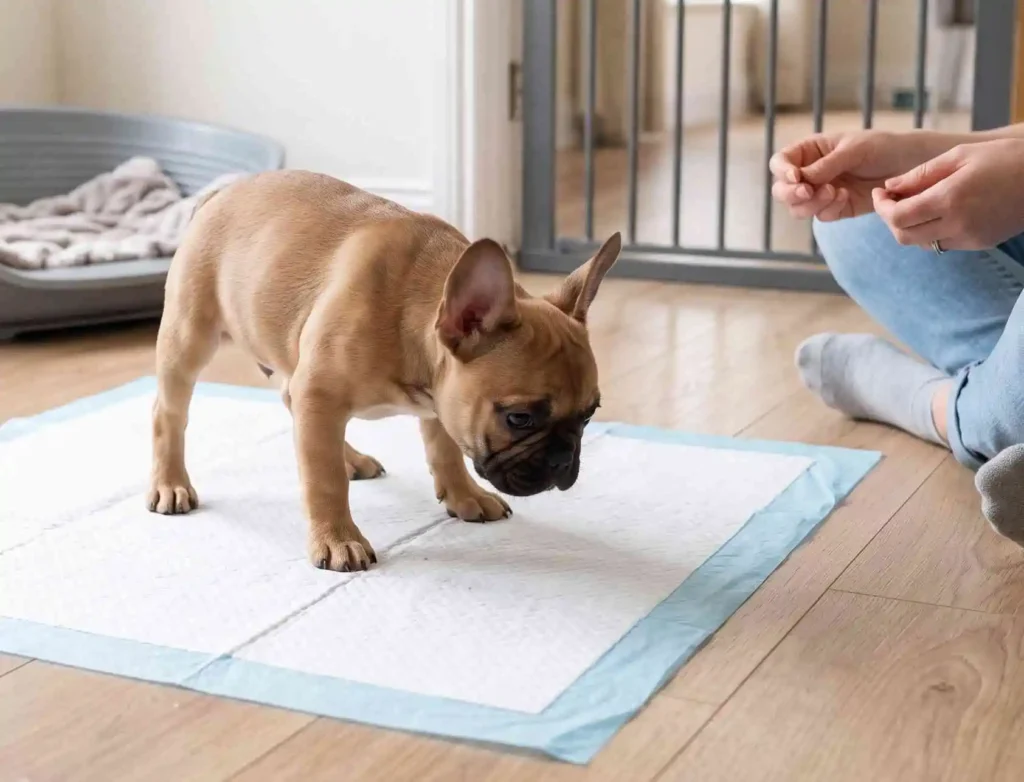
Table of Contents
Why Pad Training Matters More Than You Think
Housetraining failures are one of the top behavioral reasons dogs get surrendered to shelters. That’s a heavy consequence for something usually caused by a schedule problem, not a bad dog.
There’s a comfort angle too. A puppy who learns to hold it too long risks urinary tract infections and genuine distress. Puppies squat frequently because their bladders are small and their muscle control is immature. Expecting eight-hour patience from a nine-week-old is like expecting a toddler to sit through a three-hour movie.
Pads also matter for safety. According to the AKC, puppies aren’t fully protected until roughly two weeks after their final vaccine series, which usually lands around 16 weeks. Before then, sidewalks and dog parks carry real parvovirus risk. Pads give your pup a safe place to go while their immune system catches up. If you’re unsure about timing, it helps to understand when puppies can safely go outside before their shots are complete.
How Puppy Pads Actually Work
A modern pee pad is a layered sandwich. The top sheet is a quick-dry mesh that pulls liquid downward so paws stay dry. Beneath it sits a super-absorbent polymer core that turns urine into gel, locking it away. The bottom layer is waterproof plastic that protects your floor.
Many pads include a light attractant scent, usually a pheromone-style additive. It nudges your puppy to sniff, circle, and squat in the right place. It’s a helpful hint, not a magic switch.
Why Surface Preference Drives Everything
Dogs develop what trainers call substrate preference. By around eight to nine weeks, puppies start forming an opinion about what a bathroom should feel like underfoot. Grass, gravel, carpet, tile, pad. Whatever they use most in that window tends to become their default.
This is why consistency beats effort. Ten repetitions on the same pad build a stronger habit than fifty scattered corrections. And it’s also why carpet accidents are so sticky as a problem. Carpet feels remarkably close to a pad.
Reading Your Puppy’s Tells
Most puppies broadcast their intentions about fifteen seconds before they go. Watch for sudden sniffing with the nose glued to the floor, tight circling, a distracted pause mid-play, or wandering behind furniture. That last one matters. Puppies naturally seek privacy, so the space behind a sofa is a prime accident zone.
Learning your puppy’s signals is part of a broader picture. Understanding common puppy behavior problems makes housetraining click faster because you stop reading normal puppy behavior as defiance.
Common Mistakes (and Fixes)
Mistake 1: Moving the pad around the house. You put one in the kitchen, one by the door, one in the bedroom. Your puppy now believes the entire home is a bathroom. The fix: One pad, one spot, for at least three weeks. Add a second location only after your puppy is hitting the first one reliably.
Mistake 2: Rewarding too late. You cheer from across the room, then fetch a treat from the counter. Your puppy connects the reward with walking to the counter. The fix: Keep treats in a pouch or a jar within arm’s reach of the pad. Mark and pay within two seconds.
Mistake 3: Cleaning accidents with ordinary spray. Ammonia-based and standard household cleaners leave scent your dog can still detect. That lingering marker says “bathroom here.” The fix: Use an enzymatic cleaner formulated for pet urine. Blot first, saturate, then let it air dry without scrubbing.
Mistake 4: Free-feeding all day. Food in the bowl around the clock means unpredictable output. You can’t schedule potty breaks you can’t anticipate. The fix: Feed measured meals at set times. Most puppies need to eliminate ten to thirty minutes after eating.
Mistake 5: Punishing accidents after the fact. The classic rubbed-nose approach doesn’t teach location. It teaches fear, and your puppy starts sneaking off to pee behind the couch. The fix: Interrupt gently with a neutral sound if you catch them mid-stream, carry them to the pad, then reward whatever they finish there.
Mistake 6: Giving too much freedom too early. An unsupervised puppy in a four-bedroom house will find a quiet corner. The fix: Use a playpen, baby gates, or a leash tethered to your belt. Shrink the world until the habit is solid.
Mistake 7: Letting the pad get soaked. Puppies are cleaner than we assume. A saturated pad often gets rejected, and your pup goes beside it instead. The fix: Change after two or three uses. Use a larger or higher-capacity pad for bigger breeds.
Choosing a Pad That Doesn’t Sabotage You
Here’s the frustrating part most owners discover in week one. Cheap pads fail at exactly the wrong moment. Thin pads tear when a puppy paws at them, and low-absorbency pads let urine pool on top, which soaks paws and then tracks across your floor. Worse, a pad that leaks through to hardwood creates a scent stain underneath that keeps drawing your puppy back to the same spot even after you swap the pad.
If you’re running a real training schedule, you’re going through pads fast. Six to eight a day is normal for an eight-week-old. That makes both capacity and cost per pad matter.
Amazon Basics Dog and Puppy Pee Pads are a sensible workhorse for this stage. The five-layer construction with a leak-proof backing handles the two things that derail pad training most often: puddling and floor seepage. The quick-dry surface keeps paws from getting wet, which cuts down on tracked prints across the kitchen. Buying in a 100-count box also removes the temptation to stretch a soiled pad an extra day, which is a common source of near-miss accidents. Best suited to small and medium breeds during the training window. The honest limitation: at 22 by 22 inches, the regular size is tight for a large-breed puppy who likes to spin before squatting. Size up or overlap two if you’ve got a growing retriever.
CHECK PRICE ON AMAZON: https://amzn.to/4asfPKx
The Nighttime Problem Nobody Warns You About
Pad training and crate training work best as partners, not rivals. The crate teaches bladder control, since puppies avoid soiling where they sleep. The pad handles the hours when holding it isn’t realistic.
But new puppies often melt down at night. Whining, scratching, and the kind of crying that has you researching return policies at 3 a.m. That distress isn’t stubbornness. Your puppy just left their littermates for the first time in their life, and sleeping alone feels genuinely alarming.
A calmer puppy is a more trainable puppy, because a panicked pup can’t learn anything. The Original Snuggle Puppy Heartbeat Toy addresses this directly. It’s a plush companion with a battery-powered pulsing heartbeat and an optional warmth pack, designed to mimic the sensation of curling up against littermates. Owners commonly report shorter crying stretches within the first few nights, which means fewer frantic midnight wake-ups and fewer stress-driven accidents. It’s aimed at puppies in their first eight to twelve weeks at home. Limitation worth knowing: it’s soft plush, so a determined chewer can shred it. Supervise it as a sleep aid rather than leaving it as an all-day toy.
CHECK PRICE ON AMAZON: https://amzn.to/4kCZCoX
If nights are still rough, working through why puppies whine in the crate will help you tell hunger from anxiety from a genuine bathroom request. And pairing pads with a proper step-by-step crate training routine speeds up housetraining more than either method does on its own.
Step-by-Step: Potty Training a Puppy With Puppy Pads
- Choose the permanent spot. Pick a low-traffic area with hard flooring, away from food and water bowls. Bathrooms, laundry rooms, and kitchen corners work well. Do not move it.
- Anchor the pad. Use a pad holder tray or tape the corners. A pad that slides during use becomes a chew toy.
- Set the feeding schedule. Two or three measured meals at fixed times for puppies under six months. Pull water about two hours before bedtime.
- Build the potty timetable. Take your puppy to the pad immediately after waking, within thirty minutes of every meal, after every play session, and every 60 to 90 minutes while awake.
- Carry, don’t call. For the first two weeks, physically carry your puppy to the pad. A walking puppy often stops halfway and goes on the rug.
- Add the cue word. As your puppy starts to squat, say a quiet phrase like “go potty.” Say it during, not before. You’re labeling the action, not commanding it.
- Mark and reward instantly. The moment the stream stops, say “yes” and deliver a high-value treat right there. Two seconds. Not five.
- Wait it out. Stand with your puppy on the pad for up to five minutes. Stay boring. No play, no chatter. If nothing happens, return to the crate or pen for ten minutes and try again.
- Manage the space. Between breaks, confine your puppy to a playpen or keep them tethered to you. Unsupervised freedom is the enemy of housetraining.
- Clean accidents properly. Enzymatic cleaner, blot, saturate, air dry. Never let your puppy watch you clean up, since some pups find it stimulating.
- Track the pattern. Jot down every potty for a week. You’ll spot a rhythm within days and can preempt accidents instead of reacting to them.
- Start the outdoor transition. After seven consecutive accident-free days, begin moving the pad six inches per day toward the exterior door. When it reaches the door, place a pad just outside. Then remove it entirely.
Troubleshooting: If This, Then That
If your puppy pees right next to the pad, then the pad is too small or too soiled. Size up and change it more often.
If your puppy shreds the pad, then they’re bored, not naughty. Secure the pad in a holder and add a chew or puzzle toy during confinement time.
If your puppy holds it on the pad but goes on the carpet, then the carpet still smells like a bathroom. Deep clean with enzymatic cleaner and block access for two weeks.
If accidents spike after weeks of success, then check for a medical cause first. Frequent squatting with little output can signal a urinary tract infection.
If your puppy only goes overnight, then the last water time is too late or the crate is too large. A crate with extra room lets a pup pee in one end and sleep in the other.
If your puppy signals at the door but not the pad, then celebrate. That’s your cue to start the outdoor transition early.
If regression follows a move or new pet, then stress is the driver. Go back to a tighter schedule for two weeks. Some owners find calming products for dogs help during major household changes.
When to Call Your Veterinarian
Most pad-training struggles are training problems. A few aren’t. Book a vet visit if you notice straining without producing urine, blood in the urine, sudden dramatic increases in drinking or urinating, dribbling while asleep, crying during elimination, or a puppy over six months who’s made zero housetraining progress despite consistent effort.
Sudden regression in a previously reliable puppy deserves a phone call too. Urinary tract infections, bladder stones, and congenital issues all show up as “training failure” first.
An Evidence-Based Perspective
Veterinarians and certified trainers broadly agree that housetraining succeeds on management and reinforcement, not correction. The AVMA’s position on humane training emphasizes reward-based methods, noting that aversive techniques carry real risks of fear and anxiety without better results. In practice, that means the treat pouch does more work than the stern voice ever will.
The AKC’s housetraining guidance points to the same core mechanics: a predictable schedule, close confinement between breaks, and immediate reinforcement. Puppy pads fit inside that framework rather than replacing it. They give you a defined target when the outdoors isn’t safe or practical yet.
One honest caveat from the training world: pad-trained puppies sometimes take longer to become fully outdoor-reliable, because you’ve deliberately built an indoor habit first. That tradeoff is usually worth it for apartment owners and unvaccinated pups. Just plan the transition rather than hoping it happens on its own.
This article is general educational information and isn’t a substitute for a diagnosis from your own veterinarian.
Frequently Asked Questions
How long does it take to potty train a puppy with puppy pads? Most puppies show reliable pad use within four to six weeks of consistent training. Full reliability, meaning almost no accidents, typically arrives between four and six months of age as bladder control matures.
Should I use puppy pads or go straight outdoors? Go straight outdoors if your puppy is fully vaccinated and you have easy yard access. Use pads if you’re in an apartment, your pup isn’t vaccinated yet, or you’re gone for long stretches.
Do puppy pads make housetraining harder later? They can add a transition step, but they don’t ruin outdoor training. Plan the switch deliberately by gradually moving the pad toward the door once your puppy is reliable.
How often should I change a puppy pad? Change after two or three uses, or at least once daily. Puppies frequently refuse to use a saturated pad and will go beside it instead.
Why does my puppy pee beside the pad instead of on it? Usually the pad is too small, too dirty, or your puppy circles before squatting and runs out of room. Try a larger pad or overlap two.
Can I use puppy pads and crate training together? Yes, and it’s the strongest combination. The crate builds bladder control while the pad covers the hours when holding it isn’t reasonable.
What age should I start pad training? Start the day your puppy comes home, usually around eight weeks. Substrate preference forms early, so those first weeks carry disproportionate weight.
Do attractant sprays actually work? For many puppies, yes. The scent encourages sniffing and squatting in the right place. It’s a helpful nudge, not a replacement for schedule and rewards.
How do I stop my puppy from chewing the pads? Secure the pad in a holder tray and make sure your puppy has appropriate chew outlets. Pad shredding is almost always boredom rather than disobedience.
Is nighttime pad use normal? Very. Young puppies can’t hold it overnight. Place a pad inside a playpen attached to the crate, and expect nighttime needs to fade by four to five months.
Bringing It All Together
Potty training a puppy with puppy pads isn’t about the pads at all. It’s about rhythm. A predictable feeding schedule, one unchanging pad location, breaks every 60 to 90 minutes, and a reward delivered fast enough that your puppy actually connects it to the behavior. Skip the punishment entirely, because it only teaches your pup to hide. Expect setbacks around teething, moves, and growth spurts, and treat them as pauses rather than failures. Your next step is simple: grab a notebook tonight and log every potty for seven days. That single week of data will show you exactly when your puppy needs to go, and everything else gets easier from there.