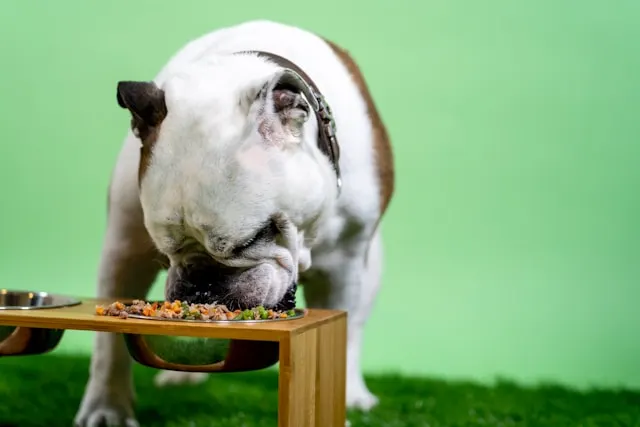
Your twelve-week-old Lab puppy inhales her breakfast in nine seconds flat, then stares at you like you’ve starved her for a month. She’s growing so fast you swear she’s a different dog every Monday. It’s tempting to just keep filling the bowl. But choosing the best puppy food for large breeds is less about generosity and more about restraint — and getting it wrong can shape your dog’s joints for life.
Quick Answer
The best puppy food for large breeds is a food formulated specifically for large-breed growth, with controlled calcium (roughly 1.0–1.5% on a dry matter basis), a calcium-to-phosphorus ratio near 1.2:1, and moderate calorie density. It should carry an AAFCO statement confirming it’s complete for growth of large-size dogs (70 lbs or more as adults). This matters most for puppies expected to top 50–70 pounds, including Labs, German Shepherds, Goldens, Cane Corsos, and Great Danes.
TL;DR: Large-breed puppies need slower, steadier growth — not faster growth. Pick a large-breed puppy formula with restricted calcium, feed measured meals rather than free-choice, and keep your puppy lean enough to feel ribs easily.
Key Takeaways
- Look for the AAFCO growth statement that specifically includes “large size dogs (70 lbs or more as an adult)” — this is the single most reliable label check.
- Calcium should be controlled, not maximized. Excess calcium during growth is linked to skeletal problems in big puppies.
- Overfeeding is more damaging than underfeeding in large breeds. Aim for a lean body condition throughout the first year.
- Feed measured portions two to three times daily instead of leaving food out all day.
- Never add calcium supplements to a complete puppy food unless a veterinarian directs you to.

Table of Contents
Why Large-Breed Puppy Nutrition Matters More Than You Think
A Chihuahua puppy multiplies its birth weight roughly 20 times. A Great Dane multiplies it about 100 times. That’s the whole issue in one sentence.
Big puppies build enormous amounts of bone and cartilage in a very short window. Their skeletons are essentially under construction while already carrying real weight. When growth is pushed too fast — by too many calories, too much calcium, or both — the cartilage at the growth plates can develop abnormally.
Veterinarians associate this pattern with developmental orthopedic diseases, including hip dysplasia, osteochondrosis, and a painful condition called hypertrophic osteodystrophy. The American Kennel Club’s nutrition guidance for large-breed puppies emphasizes controlled growth rather than maximum growth for exactly this reason.
Here’s the part owners find counterintuitive: a slower-growing large-breed puppy still reaches the same adult size. You aren’t stunting anything. You’re simply spreading the construction project over a safer timeline.
There’s a second reason to care. Weight carried during growth compounds. A puppy that’s 15% overweight at eight months is loading immature joints with force they weren’t designed to absorb yet. That damage doesn’t announce itself at eight months. It shows up at six years, as limping and stiffness that never fully resolves.
How Large-Breed Puppy Formulas Actually Differ
Walk down the pet food aisle and “large breed puppy” reads like marketing. It isn’t — at least not when the food carries the right AAFCO statement. There are real formulation differences.
Controlled calcium. Standard puppy foods can run calcium high, sometimes above 2% on a dry matter basis. Large-breed formulas typically hold it between 1.0% and 1.5%. Small puppies regulate excess calcium reasonably well by limiting absorption. Large-breed puppies are noticeably worse at it, which is why the ceiling matters.
Calcium-to-phosphorus ratio. The two minerals work as a pair. A ratio somewhere between 1:1 and 1.4:1 is the general target. Wildly skewed ratios cause problems even when the individual numbers look acceptable.
Moderate calorie density. Fewer calories per cup means a puppy can eat a satisfying volume without overshooting energy needs. Hungry puppies stay happier when the bowl looks full.
Slightly lower fat. Fat is calorie-dense. Large-breed formulas often sit around 12–16% fat rather than 18–20%.
Kibble size. A practical detail, not a nutritional one. Bigger kibble encourages chewing rather than vacuuming.
Reading the Label Without a Chemistry Degree
Flip to the AAFCO nutritional adequacy statement — usually small print near the ingredient panel. You want wording confirming the food is complete and balanced for growth including growth of large size dogs (70 lbs or more as an adult). If that large-size phrase is missing, the food wasn’t tested against the stricter mineral profile.
Ingredient lists get more attention than they deserve. A named protein in the first few slots is a reasonable sign. But the guaranteed analysis and the AAFCO statement tell you far more about safety than whether “sweet potato” appears before “peas.”
If your puppy is a breed with known skeletal sensitivities, breed-specific guidance helps too. Owners of giant working breeds often benefit from reviewing dedicated resources like this guide to feeding a Cane Corso, while German Shepherd owners face a different set of digestive considerations.
Common Mistakes (and Fixes)
- Feeding adult food to save money. Adult formulas don’t supply adequate protein and mineral balance for growth. The fix: Stay on a large-breed puppy formula until 12–18 months depending on breed size.
- Free-feeding from a full bowl. Large-breed puppies rarely self-regulate well. The fix: Measure meals with an actual cup, twice or three times daily, and pick the bowl up after 20 minutes.
- Adding calcium, cottage cheese, or bone meal. Owners do this hoping to build strong bones. It does the opposite. The fix: Feed the complete food as formulated. Skip supplements unless your vet prescribes them.
- Using “puppy” foods designed for small breeds. Small-breed puppy food is calorie-dense and often calcium-rich. The fix: Check the AAFCO large-size wording every time.
- Judging weight by eye alone. Fluffy coats hide a lot. The fix: Run your hands along the ribs weekly. You should feel them under light pressure without pressing hard.
- Switching foods abruptly. Sudden changes trigger loose stools and digestive upset. The fix: Transition over 7–10 days, increasing the new food by roughly 25% every two to three days.
- Overdoing training treats. Treats can quietly become 20% of daily calories. The fix: Cap treats at 10% and subtract that amount from meals.
The Speed-Eating Problem Nobody Warns You About
Here’s a specific problem large-breed owners run into constantly, and it’s worth solving early rather than late.
Big puppies eat fast. Really fast. A Golden Retriever puppy can empty two cups of kibble in under fifteen seconds, swallowing large volumes of air alongside the food. That leads to gas, discomfort, occasional regurgitation, and — in deep-chested breeds — raises concern about bloat, a genuine emergency in adult dogs.
Slowing the meal down is one of the easiest interventions available. A slow feeder bowl uses ridges or maze patterns to force the puppy to work around obstacles instead of gulping. Ten seconds becomes three or four minutes.
The Outward Hound Fun Feeder Slo Bowl is a well-established option for growing large-breed puppies, with a 4-cup capacity that handles the substantial portions big puppies eat. The raised flower-pattern ridges genuinely slow eating without frustrating most dogs into giving up, and the non-slip base keeps enthusiastic eaters from pushing the bowl across the kitchen. One honest limitation: the deeper channels take some effort to scrub clean, and wet or raw food can lodge in the grooves.
CHECK PRICE ON AMAZON: https://amzn.to/40buzas
For puppies that treat obstacles as a personal challenge, a more aggressive maze pattern can help. The JASGOOD Slow Feeder Dog Bowl uses a tighter anti-gulping design intended specifically for medium and large dogs prone to inhaling meals. It’s a good fit for the puppy that has already learned to shove its snout under standard ridges. The tradeoff is that some puppies find the tighter design genuinely difficult at first and may need a few meals of encouragement before they settle into it.
CHECK PRICE ON AMAZON: https://amzn.to/4bSghCM
If you want a deeper comparison of designs and how to introduce one, this slow feeder bowl guide covers the details.
Building the Right Feeding Routine: Step by Step
- Confirm your puppy’s projected adult weight. Ask your breeder or vet. Anything over roughly 50–70 pounds puts you in large-breed territory.
- Choose a food with the large-size AAFCO growth statement. This is non-negotiable. Everything else is secondary.
- Start with the bag’s feeding chart, then adjust. Charts are population averages. Your individual puppy may need 10–20% more or less.
- Split the daily total into meals. Three meals daily until about four months, then two meals daily. Consistent timing helps with house training and crate routines.
- Weigh your puppy every two weeks. Most vet clinics let you use their scale for free. Plot the numbers. Steady is good; sudden jumps are a signal to reduce portions.
- Body condition score weekly. Ribs easily felt, visible waist from above, slight tuck from the side. If ribs are hard to find, cut portions by about 10%.
- Time exercise sensibly. Avoid vigorous activity for an hour after meals, particularly in deep-chested breeds.
- Transition to adult food on breed timing. Roughly 12 months for 50–70 pound dogs, 15–18 months for giant breeds.
Troubleshooting: If This, Then That
- If your puppy finishes meals and still seems ravenous → check the body condition score first. If lean, add a small amount of green beans or a portion of the daily kibble in a puzzle feeder rather than increasing calories.
- If stools are consistently soft → slow the food transition, and consider whether treats or table scraps are the real culprit. A vet-recommended probiotic can help during transitions.
- If your puppy is growing visibly faster than littermates → reduce portions modestly and mention it at the next vet visit.
- If your puppy refuses meals for more than 24 hours → this warrants a vet call, not a food change.
- If gas and bloating follow every meal → a slow feeder is the first intervention, followed by a protein source review.
- If you notice intermittent limping or reluctance to jump → stop free-feeding immediately and book a veterinary exam.
Supporting Growth Beyond the Bowl
Nutrition is the foundation, but a few adjacent habits matter for large-breed puppies.
Joint-friendly movement beats high-impact exercise. Long leash walks on grass are better than repetitive fetch on pavement. Skip forced running and stair-heavy routines until growth plates close.
Gut health influences how well nutrients get absorbed. During food transitions or after antibiotics, a veterinary probiotic can smooth things out. Purina Pro Plan Veterinary Supplements FortiFlora is a widely used option for dogs with transition-related digestive upset, delivered as a palatable powder sprinkled over food. It’s straightforward to dose and most puppies take it readily. The limitation worth naming: it’s a short-term digestive support product, not a substitute for identifying why the stools are loose in the first place.
CHECK PRICE ON AMAZON: https://amzn.to/3ZySvV4
Beyond that, resist the urge to build a supplement shelf. A complete large-breed puppy food already contains balanced minerals, and stacking extras is where owners accidentally cause harm. If you’re curious about which additions are actually evidence-supported, this overview of dog supplements is a sensible starting point.
When to See a Veterinarian
Book an appointment if you notice:
- Limping, stiffness, or reluctance to bear weight on a limb
- Swelling or heat around the wrists, hocks, or long bones
- A bowed or crooked appearance in the front legs
- Fever combined with joint pain in a rapidly growing puppy
- Persistent vomiting, or diarrhea lasting beyond 48 hours
- Failure to gain weight despite adequate food intake
- Any bloated, tight abdomen with unproductive retching — this is an emergency
Growth-plate conditions in large breeds respond far better to early intervention. A vet visit that turns out to be nothing is a good outcome, not a wasted trip.
Expert Perspective
Veterinary nutritionists broadly agree that the goal for large-breed puppies is controlled, steady growth rather than rapid gain. The American Veterinary Medical Association’s pet nutrition resources emphasize choosing foods that meet AAFCO nutrient profiles for the appropriate life stage — and for large-breed puppies, the large-size growth designation is the specific marker to look for.
The research consensus behind this is well established. Studies following Labrador Retrievers over their lifetimes found that dogs kept lean throughout life developed hip osteoarthritis later and less severely than littermates fed more generously. That single finding reshaped how veterinarians talk about puppy feeding. Keeping a big puppy lean isn’t deprivation — it’s one of the few interventions owners fully control that measurably changes long-term joint outcomes.
This article provides general educational information and does not replace individualized veterinary advice. Your veterinarian can assess your specific puppy’s growth curve, breed risk factors, and body condition in ways no article can.
Frequently Asked Questions
When should large-breed puppies switch to adult food? Most large breeds transition around 12 months. Giant breeds like Great Danes and Mastiffs often stay on puppy food until 15–18 months, when growth plates close.
How much should I feed my large-breed puppy? Start with the bag’s chart for projected adult weight, then adjust based on body condition. Ribs should be easily felt under light pressure with a visible waist.
Is grain-free food better for large-breed puppies? Not inherently. The FDA has investigated a possible link between certain grain-free diets and canine dilated cardiomyopathy. Discuss grain-free choices with your veterinarian first.
Can I feed my large-breed puppy regular puppy food? It’s not recommended. Standard puppy formulas often contain higher calcium and calorie density than growing large breeds handle safely.
Should I add calcium or joint supplements to puppy food? No, not without veterinary direction. Complete large-breed puppy foods are already balanced, and added calcium during growth increases skeletal disease risk.
How many times a day should a large-breed puppy eat? Three meals daily until roughly four months old, then two meals daily. Measured portions work better than leaving food available all day.
Is wet food or dry food better for large-breed puppies? Either works if the AAFCO large-size growth statement is present. Dry food is more calorie-efficient and easier to measure precisely for portion control.
What’s the ideal protein level for large-breed puppies? Roughly 22–26% on a dry matter basis. Protein itself doesn’t cause skeletal problems — excess calories and calcium do.
My puppy always seems hungry. Am I underfeeding? Probably not. Check body condition rather than behavior. Large-breed puppies are frequently food-motivated regardless of how much they’ve eaten.
Can large-breed puppies eat raw diets? Raw feeding requires careful formulation to hit growth mineral targets safely. Work with a veterinary nutritionist rather than a generic recipe if you go this route.
Bringing It All Together
Choosing the best puppy food for large breeds comes down to a handful of decisions you make early and then hold steady on. Find a formula with the AAFCO large-size growth statement, keep calcium controlled, and measure every meal instead of guessing. Weigh your puppy regularly and let the scale — not your instinct to spoil her — guide portions. Keep her lean enough to feel ribs easily, and resist adding supplements to an already balanced food. A slow feeder bowl solves the gulping problem cheaply and immediately. Start today by checking your current bag’s AAFCO statement; if the large-size wording isn’t there, that’s your first change to make.