You bring home a tiny eight-week-old bundle, and suddenly your life revolves around a schedule you never planned for. Within three days, you’re mentally tracking every squat, every circle, every sniff at the back door. If you’ve found yourself wondering how often do puppies poop and whether yours is normal, you’re in good company. Nearly every new owner asks this question during the first month.
Quick Answer
Most puppies poop between three and five times per day, though some go as often as six times. Frequency depends on age, meal schedule, food type, and activity level. Younger puppies poop more often because their digestive systems move food through quickly. Tracking this number helps you spot illness early and speeds up potty training.
TL;DR: Expect 3–5 bowel movements daily for a healthy puppy, usually 5–30 minutes after each meal. Fewer than one per day or more than six watery ones signals it’s time to call your vet.
Key Takeaways
- Healthy puppies typically poop 3–5 times daily, dropping to 1–2 times as adults
- Most bowel movements happen 5–30 minutes after eating
- Stool should be firm, log-shaped, and chocolate brown
- Sudden changes in frequency, color, or consistency deserve attention
- Consistent meal timing creates predictable potty timing
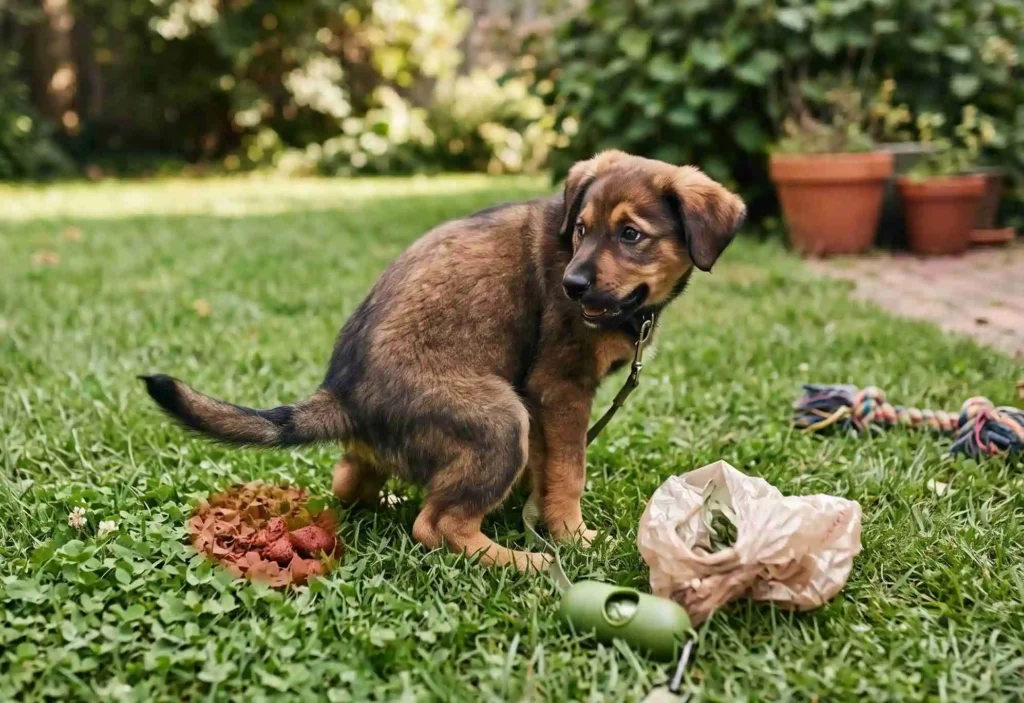
Table of Contents
Why Puppy Poop Frequency Matters
Your puppy’s bathroom habits are one of the clearest health signals you get. They can’t tell you their stomach hurts. But their stool can.
Frequent, well-formed stools mean the digestive system is doing its job. Food breaks down, nutrients get absorbed, waste moves out on schedule. When that rhythm breaks, something upstream has changed.
Puppies also dehydrate fast. A small dog losing water through repeated loose stools can crash within hours, not days. That’s why frequency matters more in a twelve-week-old than in a six-year-old Labrador.
There’s a training angle too. Once you know your puppy’s natural pattern, you can predict bathroom trips instead of reacting to accidents. That single shift shortens house training by weeks.
The Age Breakdown
Here’s roughly what to expect as your puppy grows:
6–12 weeks: 4–6 times daily. Tiny stomachs, frequent meals, fast transit time.
3–6 months: 3–4 times daily. Meals drop to three per day, and stools consolidate.
6–12 months: 2–3 times daily. The system is maturing and holding capacity improves.
Over 12 months: 1–2 times daily for most adult dogs.
These are ranges, not rules. A Great Dane puppy eating five cups a day will produce more waste than a Chihuahua on half a cup. What matters is your puppy’s personal baseline.
How a Puppy’s Digestive System Actually Works
Think of your puppy’s gut as a short, fast conveyor belt. Food enters the stomach, breaks down over two to four hours, then moves into the small intestine where nutrients get pulled out. The large intestine absorbs water from what’s left and forms the stool.
In adult dogs, that whole trip takes six to eight hours. In young puppies, it’s often faster because the intestinal tract is shorter and the gut microbiome is still developing.
That immature microbiome explains a lot. The bacterial population that helps digest food and firm up stool takes months to stabilize. Stress, diet changes, and antibiotics can knock it sideways in a day.
The Gastrocolic Reflex
Ever notice your puppy needs to go almost immediately after eating? That’s the gastrocolic reflex. When food hits the stomach, nerve signals tell the colon to make room by pushing existing waste along.
It’s strongest in young animals. Use it. Take your puppy out five to fifteen minutes after every meal and you’ll catch most of their bathroom needs before they hit the carpet.
What Healthy Puppy Poop Looks Like
Frequency is only half the picture. Consistency tells you just as much.
Aim for stool that holds its shape, feels firm but not hard, and leaves little residue when picked up. Color should be a medium to dark chocolate brown. Slight variation with different foods is normal.
Warning signs include black tarry stool, red streaks, white specks that move, gray or greasy stool, and anything watery for more than a day. If you see blood, our guide on what causes a dog to poop blood walks through the likely reasons and when to act.
Common Mistakes (and Fixes)
Free-feeding and expecting a schedule. Leaving food down all day means waste arrives unpredictably.
The fix: Serve measured meals at set times, three times daily for puppies under six months.
Switching food too fast. A sudden brand change floods the gut with unfamiliar proteins and fibers.
The fix: Transition over 7–10 days, mixing increasing amounts of the new food each day.
Overfeeding treats during training. Treats can quietly become 30% of daily calories.
The fix: Keep treats under 10% of intake and subtract from meal portions.
Panicking at one loose stool. A single soft poop after a big play session usually means nothing.
The fix: Watch for a pattern over 24 hours before worrying.
Ignoring the water bowl. Under-hydrated puppies get constipated; over-drinking after exercise causes loose stool.
The fix: Offer fresh water constantly but limit large gulps immediately after hard play.
Feeding table scraps. Fatty human food is the fastest route to puppy diarrhea.
The fix: Stick to complete puppy food and vet-approved treats.
Letting your puppy eat too fast. Gulped food arrives in the gut poorly chewed and poorly mixed with saliva.
The fix: Slow the meal down mechanically rather than scolding.
Tools That Actually Help
That last mistake deserves more attention. Puppies who inhale meals in twenty seconds often produce loose, poorly formed stool, and they’re at higher risk of gulping air. You’ll notice it as urgency and mess an hour later.
A JASGOOD Slow Feeder Dog Bowl solves this without any training effort on your part. The raised maze pattern forces your puppy to work food out of the grooves, stretching a thirty-second meal into three or four minutes. That slower pace improves chewing and gives the stomach time to signal fullness, which usually translates to firmer stool within a week. It’s best for medium and large breed puppies who eat like they’re being timed. The honest limitation: the deep grooves take real effort to scrub clean, and wet food gets stuck in the corners. If you feed raw or canned, budget an extra minute at the sink.
CHECK PRICE ON AMAZON: https://amzn.to/4bSghCM
There’s a second common scenario: the puppy whose stools stay soft through week after week of otherwise normal life. This is often the immature microbiome mentioned earlier, especially after a move, a vaccination round, or a course of antibiotics.
Purina Pro Plan FortiFlora is the probiotic most veterinary clinics reach for. Each sachet delivers a live strain of beneficial bacteria plus a palatable powder you sprinkle straight onto food. Owners typically see firmer stool within three to seven days, and the flavor coating means even picky puppies eat it without a fight. It’s genuinely useful during food transitions and post-antibiotic recovery. The limitation is cost per serving, which adds up if you use it long term rather than as a short course. It also won’t fix diarrhea caused by parasites or infection, so it isn’t a substitute for a vet visit when symptoms persist.
CHECK PRICE ON AMAZON: https://amzn.to/3ZySvV4
Step-by-Step: Building a Predictable Poop Schedule
- Set three fixed meal times. For example, 7 AM, noon, and 5 PM. Consistency matters more than the exact hours.
- Measure every portion. Use the feeding chart on your food bag as a starting point, adjusted for your puppy’s body condition.
- Take your puppy out 5–15 minutes after each meal. Same door, same patch of grass, same leash routine.
- Wait quietly for five minutes. No play, no talking, no phone. Boring is the point.
- Reward the moment they finish. Praise and a small treat within three seconds of the last squat.
- Log it for two weeks. Note time, consistency, and color. A notes app is fine.
- Add a final outing before bed. Ideally two hours after the last meal, with water pulled thirty minutes prior.
- Adjust based on your data. If your puppy consistently goes at 8:30 PM, be outside at 8:20.
This same rhythm supports crate training your puppy, since a puppy with an empty bowel settles far more easily at night.
Troubleshooting: If This, Then That
If your puppy hasn’t pooped in 24 hours → Check hydration, add a spoon of plain canned pumpkin, and increase gentle exercise. Call your vet if nothing changes by hour 48.
If stools are soft but your puppy is bright and eating → Hold the current food, skip treats for two days, and monitor. Most cases resolve on their own.
If diarrhea lasts more than 24 hours → Withhold food for 8–12 hours (puppies under four months: consult your vet first), offer water constantly, and book an appointment. Our guide to treating dog diarrhea at home covers the safe steps in detail.
If you see mucus coating the stool → Usually colon irritation. Note it, watch 48 hours, and mention it at your next visit.
If your puppy strains but produces nothing → Could be constipation or an obstruction. Obstruction is an emergency, especially if they’ve been chewing toys or socks.
If frequency doubles suddenly → Think diet change, new treats, or something scavenged on a walk. Retrace the last 24 hours.
If your puppy poops in the crate overnight → The last meal is likely too late or too large. Shift dinner earlier by an hour.
When to Call Your Veterinarian
Some signs shouldn’t wait. Contact your vet promptly if you notice:
- Blood in the stool, whether bright red or black and tarry
- Diarrhea lasting beyond 24–48 hours
- Vomiting combined with loose stool
- Lethargy, refusing food, or a hunched posture
- No bowel movement for 48 hours with visible straining
- Visible worms or rice-like segments around the rear
- Pale gums or noticeable weakness
Young puppies deteriorate quickly. When in doubt, a phone call costs nothing.
What the Experts Say
According to the American Kennel Club, diarrhea in dogs has a wide range of causes including dietary indiscretion, sudden food changes, parasites, and infectious disease, and puppies are more vulnerable to rapid dehydration than adult dogs. This is why veterinarians consistently advise treating persistent loose stool in a young puppy as time-sensitive rather than something to wait out.
The American Veterinary Medical Association emphasizes that regular veterinary care during the first year establishes the baseline your vet needs to spot problems later. Bring a fresh stool sample to those early appointments. Routine fecal testing catches roundworms, hookworms, and giardia — three common causes of frequent, loose stools in puppies that no amount of diet adjustment will fix. Everything here is general educational information and does not replace an examination and diagnosis from your own veterinarian.
Frequently Asked Questions
How many times a day should an 8-week-old puppy poop?
Around four to six times daily. At this age, puppies eat three to four small meals and their digestive transit is very fast. Frequency naturally decreases over the following months.
Is it normal for a puppy to poop after every meal?
Yes, completely normal. The gastrocolic reflex triggers a bowel movement when food enters the stomach. Most puppies go within 5–30 minutes of eating.
How long can a puppy hold their poop?
A rough guide is one hour per month of age, plus one. A three-month-old can typically hold for about four hours during the day, less when active.
Why is my puppy’s poop soft but not diarrhea?
Common causes include recent food changes, too many treats, mild stress, or an immature gut microbiome. If your puppy is otherwise energetic, monitor for 48 hours before intervening.
Should puppies poop at night?
Ideally not. Feed the last meal at least three hours before bedtime and take them out right before sleeping. Most puppies sleep through by twelve weeks.
What color should puppy poop be?
Medium to dark chocolate brown. Yellow, gray, black, or red stool warrants a vet call. Slight color shifts with diet changes are normal.
Can teething affect my puppy’s poop?
Indirectly. Puppies swallow bits of chew toys and bedding while teething, which can cause loose or unusual stool. Supervise chewing and choose age-appropriate toys.
Does dry food make puppies poop less than wet food?
Usually yes, though the difference is modest. Higher-quality food with digestible protein tends to produce smaller, firmer stools regardless of format.
When does puppy poop frequency slow down?
Most puppies drop to two or three times daily around six months, then settle at one or two by their first birthday. The change is gradual.
Do I need to worry about one hard, dry stool?
Not usually. Occasional hard stool often means slight dehydration or low fiber. Ensure constant water access and watch the next few bowel movements.
The Bottom Line
Knowing how often puppies poop turns a source of anxiety into a useful daily checkpoint. Three to five times a day is normal for most young puppies, and that number will fall naturally as they grow. Consistency, timing, and color tell you more than frequency alone ever will. Set fixed meal times, head outside within fifteen minutes of eating, and jot down what you see for two weeks. That short log will show you your puppy’s personal baseline, and any deviation from it becomes obvious. Start tracking tomorrow morning — it’s the simplest habit you’ll build this year, and the one your vet will thank you for.