You grab your keys, and it starts. The whining, the pacing, the frantic scratching at metal bars. You come home to a soaked blanket, a bent latch, and a dog who looks utterly wrung out. If a dog separation anxiety crate situation has turned your mornings into a guilt spiral, you are not failing your dog. You are dealing with a real panic response that needs a different approach than ordinary crate training.
Quick Answer
A crate can help a dog with separation anxiety, but only if the dog already feels safe inside it. Forcing an anxious dog into a crate usually makes panic worse and can cause injury. The goal is slow, positive conditioning that turns the crate into a chosen resting spot. This guide helps owners of dogs who whine, drool, or destroy things when left alone.
TL;DR
Crates do not cure separation anxiety, but they can support recovery when a dog genuinely loves the space. Build value through food, comfort, and short departures before ever closing the door on a full workday. If your dog panics, bloodies their gums, or bends bars, stop crating and call your vet.
Key Takeaways
- Separation anxiety is panic, not disobedience or spite.
- Never use the crate as punishment, or the association breaks fast.
- Build alone-time tolerance in seconds and minutes, not hours.
- Food puzzles and scent comfort lower arousal before you leave.
- Escape attempts and self-injury mean it is time for professional help.
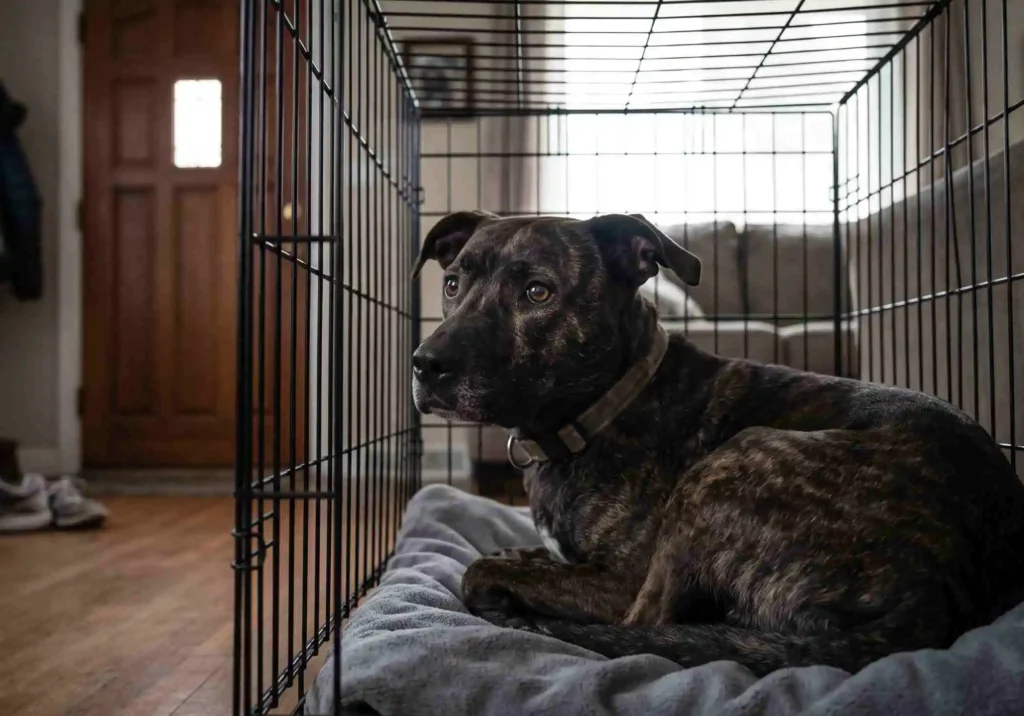
Table of Contents
Why It Matters: The Hidden Cost of Crate Panic
A panicking dog is not just noisy. They are flooded with stress hormones for the entire time you are gone. That physical state takes a toll.
Dogs who thrash inside crates commonly break teeth on the bars. Others tear nails, scrape their muzzles raw, or overheat from constant movement. Some injure their spine trying to force their body through a gap.
There is an emotional cost too. Every panicked session teaches your dog that the crate predicts terror. Repetition strengthens that lesson. What started as mild unease can harden into full refusal to enter the crate at all.
Neighbors notice, landlords notice, and owners burn out. Many dogs are surrendered for this exact reason. Getting the approach right protects both your dog’s body and your ability to keep them.
How Separation Anxiety Actually Works
Separation anxiety is a panic disorder. It is closer to a human panic attack than to a training gap. Your dog is not plotting revenge for being left behind.
The trigger is usually absence itself, or the absence of one specific person. Some dogs are fine if any human stays home. Others need their particular person and nobody else will do.
What the Body Does
When your dog registers that you are leaving, the stress response fires. Heart rate climbs. Breathing gets shallow. Drool pours out. The thinking part of the brain goes quiet while the survival part takes over.
That is why treats get ignored and commands stop working. A flooded dog cannot learn. This is the single most important thing to understand about a dog separation anxiety crate problem.
Where the Crate Fits
A crate is a container. It does not treat the panic underneath. If your dog is calm alone but chews the couch, a crate solves your problem beautifully.
If your dog is genuinely panicking, the crate adds a second stressor: confinement. Now they cannot pace, cannot check the door, cannot self-soothe by moving. For some dogs, that containment makes everything worse.
Anxiety Versus Boredom
Boredom looks like chewing shoes, digging cushions, and enthusiastic destruction. Anxiety looks like drooling, panting, refusing food, and destruction focused on exits. Boredom dogs eat their stuffed Kong. Anxiety dogs leave it untouched.
Set up a phone camera and watch the first fifteen minutes. That footage tells you almost everything. If distress starts within minutes of your exit and never settles, you are dealing with anxiety.
Common Mistakes and Fixes
Most owners get this wrong at first. That is normal, and it is fixable.
- Going straight to a full workday. You get the crate on Saturday and use it Monday for nine hours. The fix: Start with seconds. Build to minutes over weeks, not days.
- Using the crate for punishment. Your dog counter-surfs and gets crated. The fix: The crate should only predict good things. Manage the counter instead with baby gates and clear surfaces.
- Making a dramatic goodbye. Long cuddles and sad voices raise the emotional stakes. The fix: Leave boring. No speech, no lingering, no eye contact. Just go.
- Big emotional greetings on return. Hugging a dog who has been screaming rewards the arousal state. The fix: Come in calmly. Wait for four paws on the floor before you engage.
- Ignoring the video evidence. Owners assume the dog settles after a few minutes. The fix: Record every session for the first two weeks. Data beats guessing.
- Choosing the wrong crate size. Too small feels like a trap. Too large lets a dog build speed and slam into walls. The fix: Your dog should stand, turn, and lie flat comfortably, with no extra room to sprint.
- Skipping physical and mental exercise. A dog with unspent energy has nothing to do but worry. The fix: A sniffy walk and a puzzle session before departures.
Building the Crate Into a Genuine Safe Space
Here is where the work happens. Your goal is to make the crate the best real estate in your home.
Start with the crate itself. Leave the door open all day for the first week. Feed every meal inside with the door wide open. Toss treats in randomly when your dog is not looking, so the crate magically produces food.
Location matters more than most people expect. Put the crate where your family actually is. A crate exiled to the laundry room feels like banishment. A crate beside the couch feels like a den.
The Comfort Layer
Anxious dogs settle faster when the crate feels enclosed and warm rather than exposed. Drape a light blanket over three sides, leaving the front open. Reduced visual input means fewer triggers.
A sturdy, well-sized crate matters here. The MidWest Homes for Pets 24-Inch iCrate is a solid starting point for small breeds and young puppies still growing into their adult size. It folds flat for storage, includes a divider panel so the space grows with your dog, and the leak-proof tray handles the accidents anxious dogs sometimes have. The secure latches are a real benefit if your dog paws at the door. Honest limitation: wire crates are not escape-proof for a determined, powerful adult dog, and a serious panicker can bend bars. This is a comfort and containment tool, not a fortress.
CHECK PRICE ON AMAZON: https://amzn.to/4ripwkq
Scent and Sound
Puppies and small dogs often respond to physical comfort cues. Body warmth and a rhythmic heartbeat mimic littermates, which lowers arousal in young dogs especially.
The Original Snuggle Puppy Heartbeat Toy is designed for exactly this. It contains a battery-powered pulsing heartbeat unit and a heat pack pocket, giving your dog something warm and rhythmic to curl against. Owners of newly adopted puppies often report faster settling in the first nights home, and it works well tucked into a crate corner. Honest limitation: it helps mild to moderate distress in puppies far more reliably than it helps a full-blown adult panic case. Do not expect it to solve severe separation anxiety on its own.
CHECK PRICE ON AMAZON: https://amzn.to/4kCZCoX
If your dog is already whining the moment the door shuts, working through the specific patterns behind puppy whining in a crate will save you weeks of frustration.
Step-by-Step: Desensitizing Your Dog
Work through these stages in order. Do not advance until your dog stays relaxed at the current step for three sessions in a row.
- Feed all meals in the crate, door open. Three to five days. No pressure, no closing.
- Close the door for three seconds. Open before your dog reacts. Repeat ten times per session.
- Build to thirty seconds inside, door closed, you visible. Sit nearby and read. Boring is the goal.
- Add a high-value chew or stuffed food toy. Let your dog eat inside with the door closed while you stay in the room.
- Practice pre-departure cues without leaving. Pick up keys, put on shoes, then sit down. Repeat until your dog stops reacting to the cues.
- Step out of sight for five seconds. Go to another room, come back. No fanfare either direction.
- Walk out the front door and immediately return. Five seconds. Then ten. Then thirty.
- Extend to one minute, then three, then five. Vary the durations. Sometimes go shorter than the last rep so nothing becomes predictable.
- Record every absence over five minutes. Watch for the first sign of distress and set your next session below that threshold.
- Build gradually toward your real schedule. Most dogs need six to twelve weeks. Some need longer, and that is fine.
Progress is rarely linear. A bad day does not erase your work. Drop back a step or two and rebuild.
If your dog is new to confinement entirely, the foundations in this step-by-step crate training guide pair well with the desensitization work above.
Lowering Arousal Before You Leave
A dog who is already wound up cannot settle. Your departure routine should bring energy down, not up.
Give a twenty-minute sniffing walk before crating. Sniffing is genuinely calming for dogs. It engages the brain in a way that a fast jog does not.
Then give something to work on. Slow, repetitive licking has a self-soothing effect for many dogs, which is why frozen spreads inside a crate work so well.
The LUKITO Lick Mat two-pack suits owners who want a low-cost daily calming tool. Suction cups anchor it to the crate floor or wall so it does not become a chew toy, and it takes wet food, plain yogurt, or peanut butter without xylitol. Frozen, it can stretch a five-minute snack into twenty minutes of quiet work. Honest limitation: it is not durable against a dog who chews rather than licks, so supervise the first few uses before leaving it in an unattended crate.
CHECK PRICE ON AMAZON: https://amzn.to/4aQdOHT
Mental work tires dogs more efficiently than physical work alone. Rotating in interactive toys that provide mental stimulation throughout the week keeps enrichment from getting stale.
Some owners also explore supplements. Talk to your vet before adding anything, and treat calming aids as support for a training plan rather than a replacement for one. This overview of calming products for dogs explains what the different categories actually do.
Troubleshooting: If This, Then That
- If your dog whines for under two minutes then settles: Then you are on track. Keep durations the same for a few more sessions.
- If whining escalates instead of fading: Then you moved too fast. Cut your absence time in half.
- If your dog refuses to enter the crate at all: Then the association has soured. Go back to open-door feeding for a full week.
- If your dog drools heavily but stays quiet: Then they are still panicking silently. Silence is not the same as calm.
- If food goes untouched during absences: Then your dog is over threshold. Shorten the absence until they will eat.
- If your dog is fine when anyone is home: Then this is general separation anxiety, not attachment to one person. Practice absences with other household members too.
- If your dog panics only in the crate but is calm loose in a room: Then skip the crate. Use a puppy-proofed room or exercise pen instead.
- If progress stalls for three straight weeks: Then loop in your veterinarian about medication support.
When to See a Professional
Some cases need more than a training plan. Call your veterinarian if you see any of these.
Self-injury is the clearest red flag. Bloody gums, torn nails, worn paw pads, or facial abrasions mean stop crating immediately. Continuing risks serious harm.
Call your vet if your dog is destroying the crate structure, refusing all food for hours, or losing weight. Also call if the anxiety appeared suddenly in an adult dog who was previously fine. Sudden onset can signal pain, cognitive decline, or another medical issue.
A veterinary behaviorist is worth the referral for severe cases. Medication is not a failure or a shortcut. For panic disorders, it often makes the training possible in the first place by lowering the baseline enough for your dog to learn.
Expert Perspective
The American Kennel Club describes separation anxiety as a genuine distress response rather than a behavior problem born of disobedience, and emphasizes that gradual desensitization to departures is the core of any effective plan. The AKC also cautions against using crates punitively, since a dog who associates confinement with negative outcomes will resist it far more strongly. Veterinarians consistently recommend ruling out medical causes before treating sudden-onset anxiety as purely behavioral, particularly in older dogs.
The American Veterinary Medical Association highlights the value of a combined approach for anxiety disorders, pairing behavior modification with veterinary support where warranted. Owners often hesitate to discuss medication, but for dogs whose panic prevents any learning from taking place, pharmaceutical support can be what makes a training protocol viable. Your veterinarian is the right person to weigh those options against your individual dog’s history. You can read the AKC’s guidance on separation anxiety in dogs and the AVMA’s material on animal behavior and welfare for further background.
This article is general educational information. It is not a veterinary diagnosis or a substitute for individualized advice from your own vet.
Frequently Asked Questions
Should I crate a dog with separation anxiety? Only if your dog is already comfortable in the crate. For dogs who panic when confined, crating adds a second stressor and can cause injury. A puppy-proofed room or pen is often safer.
Does crate training help separation anxiety? Crate training does not treat the underlying panic. It can support recovery by giving an anxious dog a predictable safe space, but the real work is gradual desensitization to your absence.
How long can a dog with separation anxiety be crated? Start with seconds and build slowly based on your dog’s tolerance, not the clock. Most dogs need six to twelve weeks of gradual work before handling a normal workday.
Why does my dog panic in the crate but not when loose? Confinement removes their ability to pace, check exits, and self-soothe through movement. Some dogs tolerate absence fine but cannot tolerate being contained during it.
Should I cover the crate for an anxious dog? Covering three sides often helps by reducing visual triggers and creating a den-like feel. Leave the front open for airflow and so your dog does not feel completely trapped.
Do calming products actually work for crate anxiety? They can lower baseline arousal enough to make training possible. They rarely solve severe cases alone. Always discuss supplements with your veterinarian before starting.
Is my dog’s crate the right size? Your dog should stand, turn around, and lie fully stretched out. Extra space beyond that lets an anxious dog build momentum and injure themselves against the walls.
Should I ignore whining in the crate? Ignore brief settling whines. Escalating distress means your dog is over threshold and you moved too fast. That is information to act on, not noise to wait out.
Can separation anxiety be cured? Many dogs improve dramatically with consistent work. Some retain a mild sensitivity long term. Realistic success means your dog rests calmly alone, not that anxiety vanishes forever.
When should I call a vet about crate anxiety? Call if your dog self-injures, destroys the crate, refuses food for hours, or if the anxiety appeared suddenly in a previously relaxed adult dog.
Final Thoughts
A dog separation anxiety crate problem feels enormous when you are living inside it. The scratched paint, the neighbor’s texts, the guilt every time you reach for your keys. But this is solvable for most dogs with patience and a plan that moves at your dog’s pace rather than yours. Build genuine value into the crate before you ever ask for a long absence. Record your sessions so you are working with facts instead of hope. Lean on your veterinarian early, especially if you see self-injury or sudden onset. Start tonight with something small: feed dinner in the crate with the door wide open, and let your dog discover that good things happen in there. That single change is where most recoveries begin.