Your dog trots over for a cuddle, and the moment he opens his mouth, you lean back fast. Sound familiar? Dog bad breath is one of the most common complaints among pet owners — and one of the most overlooked. That sour, fishy, or downright funky smell isn’t just unpleasant. It can be a real signal that something is off inside your dog’s body. Understanding what’s behind bad breath in dogs is the first step toward fixing it and keeping your pup genuinely healthy.
What Is Dog Bad Breath — and Is It Normal?
Quick Answer: Dog bad breath (halitosis) is persistent unpleasant odor from a dog’s mouth, most often caused by bacterial buildup on the teeth and gums. It can also point to digestive issues, kidney disease, or diabetes. It affects dogs of all ages and breeds, but it’s especially common in small breeds prone to dental crowding.
TL;DR: Mild doggy breath is common, but a sharp, fishy, or sweet smell usually signals a fixable problem. Most cases come down to poor dental hygiene, diet, or an underlying health condition.
Key Takeaways
- Bad dog breath is usually caused by bacteria, tartar buildup, or gum disease — not “just being a dog.”
- Certain smells (fruity, ammonia-like, fishy) point to specific health conditions beyond the mouth.
- Daily toothbrushing is the single most effective prevention tool.
- Diet, probiotics, and dental chews all play supporting roles in oral health.
- Persistent or suddenly worsening bad breath warrants a vet visit.
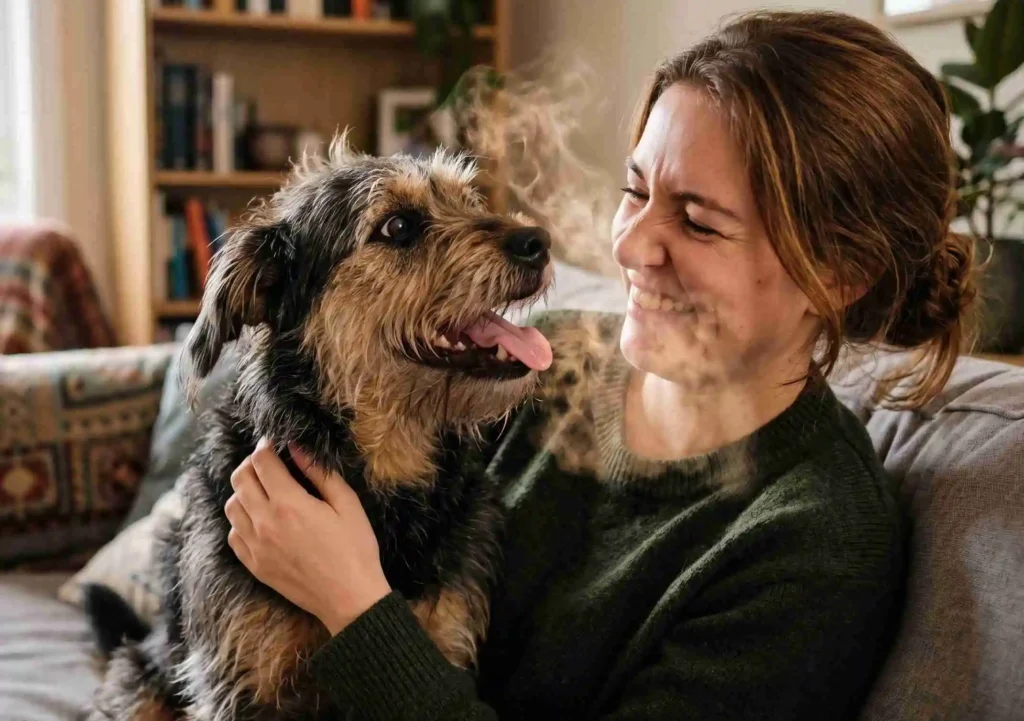
Table of Contents
Why Dog Bad Breath Matters More Than You Think
Dismissing bad breath as a normal dog thing is a mistake a lot of owners make. The reality is that periodontal disease affects an estimated 80% of dogs over age three, according to the American Veterinary Medical Association. Left unchecked, oral bacteria don’t stay in the mouth. They can enter the bloodstream and cause damage to the heart, kidneys, and liver over time.
Bad breath in dogs also hurts quality of life for both of you. Dogs who are uncomfortable due to gum pain may eat less, avoid chewing, or become irritable. And you’re less likely to snuggle, train, or bond with a dog whose breath clears the room.
The good news? Most causes of bad dog breath are preventable and treatable once you understand what’s driving the smell.
The Biology Behind Dog Breath: What’s Actually Happening
A dog’s mouth is home to hundreds of bacterial species. Most are harmless. Problems start when plaque — a sticky film of food debris and bacteria — accumulates on the teeth. Within 24 to 48 hours, plaque hardens into tartar (also called calculus). Tartar is rough and porous, which means it traps even more bacteria.
Those bacteria break down proteins and produce volatile sulfur compounds (VSCs) — the same compounds responsible for human bad breath. VSCs smell like rotten eggs, old garbage, or something vaguely fishy. The more tartar and inflamed gum tissue present, the more VSCs get produced, and the worse the breath gets.
Beyond the mouth, the digestive system plays a role too. Gases produced during digestion can travel back up the esophagus and escape through the mouth, adding another layer to the odor. If your dog tends to eat grass regularly, it may indicate a digestive imbalance that can also contribute to breath issues.
What Your Dog’s Breath Might Be Telling You
Not all bad breath smells the same — and the type of smell actually matters.
General “doggy” odor — Mild, slightly stale smell after meals or first thing in the morning. Usually just food residue and normal bacteria. Improves with brushing.
Sweet or fruity smell — This is a red flag. A sweet or acetone-like odor can indicate diabetic ketoacidosis, a serious metabolic condition. See a vet promptly.
Ammonia or urine-like smell — This can point to kidney disease, where the kidneys can’t filter waste properly. The excess urea gets expelled through breath. Don’t wait on this one.
Fishy smell — Often a sign of anal gland secretions transferred during self-grooming, but it can also point to periodontal disease or digestive issues. Worth investigating.
Foul, rotting smell — Classic sign of advanced gum disease, a tooth abscess, or oral infection. Usually accompanied by visible tartar, red gums, or drooling.
If you’re also noticing symptoms like excessive drooling, difficulty eating, or pawing at the mouth, the issue likely goes beyond simple plaque buildup.
Common Mistakes Dog Owners Make (and the Fixes)
Most bad breath problems get worse because of easy-to-avoid habits. Here’s where owners go wrong:
- Only brushing once a week or less. Plaque hardens into tartar in as little as 48 hours. The fix: brush your dog’s teeth daily, or at minimum every other day. Even 60 seconds makes a real difference.
- Using human toothpaste. Human toothpaste contains fluoride and xylitol, both of which are toxic to dogs. The fix: always use toothpaste formulated for dogs, ideally an enzymatic formula that keeps working even after you stop brushing.
- Relying only on dental chews. Dental chews help, but they don’t replace brushing. The fix: use chews as a supplement to brushing, not a replacement.
- Feeding low-quality kibble with high sugar or filler content. Starchy, sugary ingredients feed oral bacteria. The fix: check ingredient labels and opt for whole-protein-first formulas.
- Ignoring small breed dental needs. Small dogs have crowded teeth that trap food and bacteria more easily. The fix: small breeds need more frequent dental attention, not less.
- Skipping annual vet dental checkups. Even great home care misses tartar in hard-to-reach spots. The fix: schedule a professional dental cleaning once a year, or as recommended by your vet.
- Not checking the mouth regularly. Most owners notice bad breath long before they look at the teeth and gums. The fix: get your dog comfortable with mouth handling early, and do a quick visual check monthly.
The Right Tools Make Daily Dental Care Actually Happen
The number one reason dog owners skip brushing is that it’s awkward and uncomfortable — for both dog and human — when you don’t have the right setup. Once gum disease gets serious, home care alone can’t reverse it, and professional cleanings under anesthesia become necessary. That’s an expensive and stressful road to avoid.
Starting with a proper kit designed for dogs takes most of the friction out of the routine. The Virbac C.E.T. Oral Hygiene Kit for Dogs is a vet-recommended option that includes everything you need in one package: a dual-ended pet toothbrush, a fingerbrush for dogs who resist standard brushes, and poultry-flavored enzymatic toothpaste. The enzymatic formula is the key feature here — it continues breaking down plaque even after the brushing session ends, which makes it far more effective than non-enzymatic pastes. The poultry flavor helps most dogs accept brushing quickly. The honest limitation is that dogs with severe existing tartar will still need a professional cleaning before home brushing becomes fully effective. But for maintenance and prevention, this kit is one of the best starting points available.
CHECK PRICE ON AMAZON: https://amzn.to/4bXfiRW
Step-by-Step: How to Actually Fix Bad Dog Breath
Tackling bad breath in dogs isn’t complicated — it just needs to be consistent. Follow this approach:
- Do a quick mouth inspection first. Look for visible tartar (yellow-brown buildup near the gumline), red or bleeding gums, loose teeth, sores, or growths. If you see anything concerning, visit your vet before starting a home routine.
- Introduce toothbrushing gradually. Start by letting your dog lick toothpaste off your finger. Then add the fingerbrush. Then transition to the full toothbrush. Take 3–7 days per stage for anxious dogs.
- Brush in small circles along the gumline. Focus on the outer surfaces of the upper back teeth — that’s where tartar accumulates fastest. Aim for 60–90 seconds total.
- Add a dental chew after meals. Look for products with the Veterinary Oral Health Council (VOHC) seal of approval, which means the efficacy has been independently verified.
- Evaluate the diet. Whole proteins, low starch, and good moisture content all contribute to a healthier oral environment. If you’re unsure about your dog’s current food, reading a detailed breakdown of raw vs. kibble feeding options can help you make a more informed decision.
- Support gut health. Digestion plays a bigger role in breath than most owners realize. A healthy gut microbiome produces less odor-causing gas. Adding a probiotic supplement is one of the easier ways to address this from the inside out.
- Keep fresh water available constantly. Dehydration thickens saliva and allows bacteria to thrive. A dog who drinks enough water naturally rinses the mouth more frequently.
- Schedule a professional dental cleaning annually. Home care maintains oral health — it doesn’t replace professional scaling. Your vet or veterinary dentist can remove tartar below the gumline that no brush can reach.
Supporting Gut Health to Reduce Bad Breath From the Inside
A lot of people focus entirely on the mouth when addressing bad dog breath and completely miss the digestive component. The gut and the mouth are connected — literally. An imbalanced gut microbiome can produce gases that travel upward, and the bacteria responsible for poor digestion often overlap with those that cause oral odor.
If your dog also shows signs like soft stools, occasional digestive upset, or seems generally gassy, the gut may be contributing to the breath problem just as much as the teeth.
The Purina Pro Plan Veterinary Supplements FortiFlora Daily Probiotics for Dogs is one of the most widely used and vet-recommended probiotic supplements available without a prescription. Each sachet contains a guaranteed level of live, active cultures (specifically Enterococcus faecium SF68) that supports a balanced gut microbiome. It’s particularly useful during or after antibiotic use, after dietary changes, or for dogs with chronically sensitive digestion. The main limitation is that it’s a single-strain probiotic, so dogs with more complex gut issues may benefit from a broader-spectrum option discussed with their vet. That said, for day-to-day gut support, it’s a reliable and easy-to-use choice.
CHECK PRICE ON AMAZON: https://amzn.to/3ZySvV4
Troubleshooting: If/Then Guide for Dog Bad Breath
Use this quick guide to diagnose your specific situation:
- If the smell is mild and food-related → Add daily brushing and a dental chew. Reassess in two weeks.
- If the smell is foul and gums look red or inflamed → Schedule a vet dental exam. Don’t delay — this is active gum disease.
- If the smell is sweet or fruity → See your vet promptly. Rule out diabetes.
- If the smell is ammonia-like → Vet visit required urgently. Could be kidney disease.
- If breath improved after brushing but returned quickly → Add a probiotic and evaluate diet quality.
- If your dog resists brushing completely → Try a dental spray or water additive as a bridge while you work on desensitization.
- If you notice drooling, pawing at mouth, or reluctance to eat alongside bad breath → This points to pain. Vet visit, not home care.
- If your dog eats its own feces (coprophagia) → Address this behavior directly; it will override any oral hygiene routine.
When to See a Professional
Home care goes a long way, but there are situations where a vet visit isn’t optional. Look out for these signs:
- Bad breath that appeared suddenly and is much worse than usual
- A sweet, fruity, or ammonia-like odor (possible systemic disease)
- Visible tartar covering more than a quarter of the tooth surface
- Red, swollen, or bleeding gums
- Loose or broken teeth
- Sores, lumps, or discoloration in the mouth
- Reluctance to eat, weight loss, or lethargy alongside bad breath
- No improvement after two weeks of consistent brushing
A full veterinary dental cleaning under anesthesia is the only way to remove subgingival (below the gumline) tartar and treat early periodontal disease. According to the American Kennel Club, most adult dogs benefit from at least one professional cleaning per year.
Expert Opinion
Veterinarians consistently identify periodontal disease as the most underdiagnosed health condition in companion animals. The challenge is that early gum disease causes no visible pain — dogs are stoic and will continue eating and behaving normally even as inflammation progresses below the gumline. By the time an owner notices the smell is bad, the disease is often moderate to advanced.
The AVMA recommends that dental care begin in puppyhood — not just to clean teeth, but to build the behavioral tolerance that makes brushing a non-event for adult dogs. A dog that’s been handled around the mouth from 8 weeks old will accept a toothbrush far more readily at age 5 than one whose first experience with oral care happens at that age. The single most impactful thing an owner can do is start a brushing routine early and keep it consistent. Everything else — chews, water additives, diet — is supportive, not a substitute.
This article provides general health information for dog owners and is not a substitute for professional veterinary diagnosis or treatment. Always consult your veterinarian for concerns about your dog’s health.
Frequently Asked Questions About Dog Bad Breath
Why does my dog have bad breath even though I brush his teeth?
If you’re brushing regularly but the smell persists, tartar below the gumline (which brushing can’t remove), a dietary issue, or a systemic health condition like kidney disease could be the cause. A vet dental exam is the next step.
Is bad dog breath normal?
Mildly “doggy” breath after a meal is normal. Persistent, strong, or sudden bad breath is not. It nearly always points to dental disease, digestive imbalance, or an underlying health issue that’s worth addressing.
What causes bad breath in dogs beyond teeth?
Bad breath in dogs can stem from digestive issues, kidney disease, diabetes, liver problems, respiratory infections, or even diet. If brushing doesn’t help, the source may be systemic rather than oral.
How often should I brush my dog’s teeth?
Daily brushing is ideal. Every other day is the minimum recommended for effective plaque control. Even once a week is better than nothing, but it won’t prevent tartar buildup on its own.
Do dental chews actually work for bad dog breath?
Dental chews with the VOHC seal have been shown to reduce plaque and tartar. They help, but they shouldn’t replace brushing. Think of them as a supplement, not a solution.
Can diet cause bad breath in dogs?
Yes. High-starch, low-quality kibble feeds oral bacteria. Certain foods like fish or organ meats can also temporarily worsen breath. Switching to a higher-quality, protein-forward diet often helps over time.
What does fruity or sweet breath in dogs mean?
A sweet or fruity smell can indicate diabetic ketoacidosis — a serious metabolic condition. It requires prompt veterinary attention, not a home remedy.
Can bad breath in dogs be a sign of kidney disease?
Yes. An ammonia or urine-like odor from a dog’s mouth can indicate the kidneys aren’t filtering waste effectively. This requires urgent veterinary evaluation.
Are water additives effective for bad dog breath?
Some water additives contain enzymes or antibacterial ingredients that modestly reduce oral bacteria. They’re useful as part of a broader dental routine but aren’t a standalone solution.
At what age should I start dental care for my dog?
As early as possible — ideally from puppyhood. Getting your dog comfortable with mouth handling and brushing before 6 months of age makes lifelong dental care much easier for both of you.
The Bottom Line on Dog Bad Breath
Dog bad breath is common, but it’s not something you have to just live with — and more importantly, you shouldn’t ignore it. Most cases of bad dog breath trace back to plaque buildup, gum disease, or a digestive imbalance, all of which are manageable with the right daily habits and a little consistency.
Start with the basics: brush your dog’s teeth regularly using a dog-safe enzymatic toothpaste, support gut health through diet and probiotics, and get a professional dental cleaning at least once a year. Pay attention to the type of smell — fruity, ammonia, or suddenly worsening odors are signals to get your vet involved sooner rather than later.
If you’re looking to build a more complete wellness foundation for your dog, exploring a good guide to dog supplements can help you understand what else supports long-term health beyond just dental care. And if you want to go further on nutrition, learning about superfoods that improve canine health and longevity is a great next step.
You’ve already taken the right first step by looking for answers. Now put one small habit in place today — even just picking up a proper dental kit — and your dog’s breath, health, and quality of life will thank you for it.