You brought home a Bernese Mountain Dog because of that gentle face and goofy personality. Now you want to keep your big, lovable companion healthy for as long as possible. Understanding Bernese Mountain Dog health issues early gives you the best shot at prevention — and more good years together. This guide breaks down every major concern, what you can actually do about each one, and when it’s time to call your vet.
Quick Answer
Bernese Mountain Dogs are prone to several serious health conditions, including hip and elbow dysplasia, certain cancers (especially histiocytic sarcoma), bloat, and progressive retinal atrophy. Their average lifespan of 7–10 years is shorter than many breeds, largely due to these genetic predispositions. Early screening, proper nutrition, and consistent veterinary care can help manage risks and improve quality of life.
TL;DR: Berners face higher-than-average risks for joint disorders, cancer, and bloat. Responsible breeding, regular vet visits, joint support, and a healthy weight are your strongest tools for keeping them well.
Key Takeaways
- Hip and elbow dysplasia are the most common orthopedic issues — early screening and weight management reduce severity.
- Cancer accounts for roughly 50% of Bernese Mountain Dog deaths, with histiocytic sarcoma being breed-specific.
- Bloat (GDV) is a life-threatening emergency that deep-chested breeds like Berners face at higher rates.
- Joint supplements and an orthopedic bed can meaningfully improve comfort, especially after age 4–5.
- A strong relationship with your vet is your single best investment in your Berner’s long-term health.
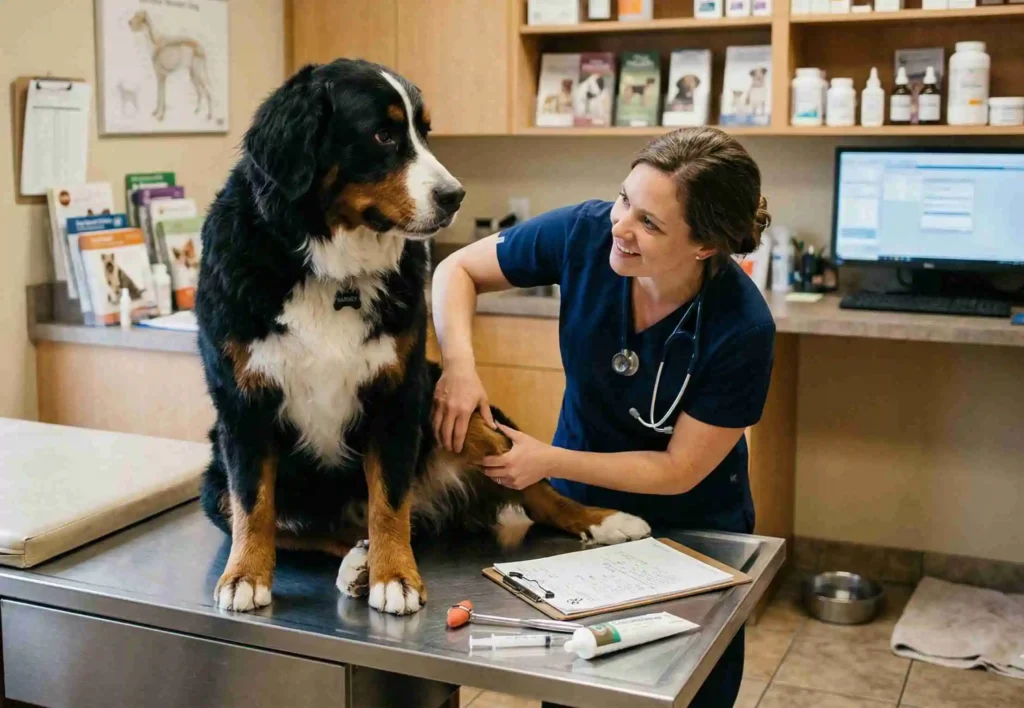
Table of Contents
Why Bernese Mountain Dog Health Issues Matter
It’s not about scaring you. It’s about being prepared. Bernese Mountain Dogs are wonderful family dogs, but they carry a heavier genetic burden than most breeds. According to the Bernese Mountain Dog Club of America, their lifespan has actually decreased over the past few decades due to rising cancer rates.
Knowing what to watch for means catching problems early, when treatment is most effective. A Berner owner who understands the breed’s vulnerabilities can make smarter choices about diet, exercise, supplements, and screening schedules. That awareness often translates into more comfortable years for your dog — and fewer emergency vet visits for you.
If your Berner ever shows signs like unexplained limping, don’t assume it’s just a pulled muscle. Large breeds deserve a closer look.
The Most Common Bernese Mountain Dog Health Issues
Hip and Elbow Dysplasia
This is the big one for joint health. Dysplasia means the ball-and-socket joint doesn’t fit together properly. Over time, this causes grinding, pain, and arthritis. The American Kennel Club lists hip and elbow dysplasia as primary health concerns for the breed.
Symptoms usually show up between 6 months and 2 years. You might notice your Berner bunny-hopping when running, struggling to stand after lying down, or showing reluctance on stairs. Some dogs hide pain remarkably well, so annual hip evaluations through OFA (Orthopedic Foundation for Animals) screenings matter.
Weight plays a huge role here. Every extra pound puts additional stress on already vulnerable joints. Keeping your Berner lean — you should feel their ribs without pressing hard — is one of the simplest and most effective things you can do.
Cancer
This is the hardest topic for Berner owners, but it’s essential. Studies suggest that cancer is responsible for approximately half of all Bernese Mountain Dog deaths. Histiocytic sarcoma, a particularly aggressive form, occurs at dramatically higher rates in this breed than in virtually any other.
Other cancers that affect Berners include mast cell tumors, lymphoma, and osteosarcoma. Warning signs vary, but watch for sudden weight loss, lumps that grow quickly, persistent lethargy, loss of appetite, and unexplained lameness.
Early detection is everything. Run your hands over your dog’s body weekly, checking for new lumps or swelling. Report anything unusual to your vet promptly. Some owners opt for regular ultrasound screenings after age 5.
Bloat (Gastric Dilatation-Volvulus)
Bloat happens when the stomach fills with gas and twists on itself, cutting off blood flow. It can kill a healthy dog within hours. Deep-chested, large breeds like Bernese Mountain Dogs are at elevated risk.
Signs include a visibly distended abdomen, unproductive retching, restlessness, drooling, and rapid breathing. If you see these signs, get to an emergency vet immediately. This is not a wait-and-see situation.
Prevention tips include feeding two or three smaller meals instead of one large meal, avoiding exercise right after eating, and using a slow feeder bowl to reduce gulping. If your Berner tends to drool excessively after meals combined with restlessness, talk to your vet about bloat risk.
Feeding from a slow feeder can genuinely reduce how fast your dog inhales food, which lowers bloat risk. The JASGOOD Slow Feeder Dog Bowl is built for large breeds and uses a maze-like pattern that forces dogs to eat at a healthier pace. It’s sturdy enough for a Berner’s big muzzle and has a non-slip base so it won’t slide across the floor. The only downside is that some very determined dogs figure out the pattern quickly and may need rotation with a different design. For a breed prone to bloat, this is a practical daily safeguard.
CHECK PRICE ON AMAZON: https://amzn.to/4bSghCM
Progressive Retinal Atrophy (PRA)
PRA is a degenerative eye disease that gradually destroys the retina, eventually leading to blindness. It’s inherited, and responsible breeders test for it before breeding. Early signs include difficulty seeing in dim light, bumping into objects in dark rooms, and dilated pupils.
There’s no cure for PRA, but dogs adapt remarkably well to vision loss when their environment stays consistent. Keep furniture in the same place, use verbal cues during walks, and avoid rearranging your home layout.
Von Willebrand’s Disease
This is a blood-clotting disorder that can cause excessive bleeding after surgery, injury, or even a minor cut. It ranges from mild to severe. Your vet can test for it with a simple blood panel, and it’s wise to know your Berner’s status before any surgical procedure.
Thyroid Issues (Hypothyroidism)
Bernese Mountain Dogs are predisposed to hypothyroidism, where the thyroid gland doesn’t produce enough hormones. Symptoms include weight gain despite normal eating, hair loss, lethargy, and recurring skin infections. A blood test confirms the diagnosis, and daily medication manages it effectively.
Common Mistakes Berner Owners Make (and Fixes)
- Over-exercising puppies. Berner puppies are still growing until 18–24 months. Hard running and jumping on developing joints accelerates dysplasia. The fix: follow the “5 minutes per month of age” rule for structured exercise. Free play on soft ground is fine.
- Ignoring weight management. This breed loves food, and those pleading eyes are hard to resist. The fix: measure meals precisely, limit treats to 10% of daily calories, and weigh your dog monthly.
- Skipping joint supplements. Many owners wait until their dog is already limping. The fix: start a glucosamine and chondroitin supplement by age 2–3 as a preventive measure, especially if you know dysplasia runs in the bloodline. You can learn more about choosing the right option in our complete dog supplements guide.
- Not learning bloat first aid. Owners who don’t recognize bloat symptoms lose precious time. The fix: memorize the signs (distended belly, unproductive retching, restlessness) and know the fastest route to your emergency vet.
- Feeding one large meal per day. This increases bloat risk significantly. The fix: split daily food into two or three meals, and wait at least 30 minutes after eating before any activity.
- Neglecting dental care. Dental disease can worsen systemic inflammation, compounding joint and heart issues. The fix: brush teeth several times per week or use veterinary dental chews.
Supporting Your Berner’s Joints Proactively
Joint problems are nearly universal in this breed. The question isn’t whether your Berner will experience some joint discomfort — it’s how much you can minimize it.
A quality glucosamine supplement, started early, provides building blocks for cartilage maintenance. Wuffes Advanced Dog Hip and Joint Supplement combines glucosamine, chondroitin, MSM, omega-3s, and green-lipped mussel in a single chew. It’s designed for daily use and the pork flavor means most dogs take it willingly. Owners report visible improvements in mobility within 4–6 weeks. One limitation: the 60-count bag runs out faster for larger dogs who need higher doses, so budget for more frequent reorders.
CHECK PRICE ON AMAZON: https://amzn.to/4aRkWUs
Beyond supplements, where your Berner sleeps matters more than you’d think. Sleeping on hard floors or flat beds puts constant pressure on hips and elbows. An orthopedic memory foam bed supports body weight evenly and reduces morning stiffness. The PetFusion Ultimate Dog Bed uses solid memory foam (not shredded fill), has a waterproof liner for accidents, and the bolster design gives Berners a place to rest their heavy heads. The removable cover is machine-washable, which is a must for a breed that sheds heavily. The main drawback is the price point — but for a dog with known joint vulnerabilities, it pays for itself in comfort.
CHECK PRICE ON AMAZON: https://amzn.to/46TYkQO
Step-by-Step: A Proactive Health Plan for Your Bernese Mountain Dog
- Choose a reputable breeder who provides OFA hip and elbow certifications, cardiac evaluations, and eye clearances for both parents. Ask for the health history of previous litters.
- Establish a vet relationship early. Schedule your first visit within a week of bringing your Berner home. Discuss a vaccination schedule and a breed-specific screening timeline.
- Start joint supplementation by age 2–3. Don’t wait for symptoms. Prevention is far more effective than treatment for dysplasia management.
- Monitor weight monthly. Use a body condition score chart from your vet. Berners should have a visible waist when viewed from above and ribs you can feel easily.
- Feed two to three measured meals daily using a slow feeder bowl. Avoid elevated food bowls — despite old advice, studies show they may increase bloat risk.
- Perform weekly body checks. Run your hands over your dog’s entire body, feeling for new lumps, swelling, or tender spots. Check ears, eyes, teeth, and paw pads.
- Keep exercise moderate and consistent. Berners need daily movement, but avoid high-impact activities like distance running on pavement. Swimming is excellent low-impact exercise for this breed.
- Schedule annual health screenings after age 4, including bloodwork, urinalysis, and a physical exam. Discuss ultrasound screenings with your vet if cancer is a concern.
Troubleshooting: If/Then Quick Reference
- If your Berner is limping intermittently → restrict activity for 48 hours and schedule a vet visit. Don’t give human pain medication.
- If you notice a new lump → measure it, photograph it, and call your vet within the week. Rapid growth warrants an urgent appointment.
- If your dog’s belly looks swollen and they’re trying to vomit without producing anything → go to the emergency vet immediately. This could be bloat.
- If your Berner suddenly gains weight without eating more → request a thyroid panel at your next vet visit.
- If your dog seems stiff in the morning but loosens up after walking → this is early arthritis. Start or increase joint supplementation and consider an orthopedic bed.
- If your Berner is panting excessively at night → it could signal pain, anxiety, or an underlying health issue. Note frequency and context for your vet.
When to See a Veterinarian
Some situations can’t wait. Contact your vet immediately if you observe:
- A distended, hard abdomen with unproductive retching (possible bloat — minutes matter)
- Sudden inability or refusal to bear weight on a limb
- Rapid, unexplained weight loss over a few weeks
- Bleeding that doesn’t stop within 10 minutes of pressure
- Collapse, seizures, or loss of consciousness
- Any lump that doubles in size within 2–4 weeks
- Persistent vomiting or bloody stool lasting more than 24 hours
For non-emergency concerns — mild limping, gradual weight changes, skin issues — schedule a regular appointment. Don’t wait for your annual checkup if something feels off. You know your dog best.
Expert Insight
Veterinarians who specialize in large breeds consistently emphasize that the single most impactful thing a Bernese Mountain Dog owner can do is maintain a lean body weight. The American Veterinary Medical Association notes that obesity worsens virtually every health condition common to this breed — from dysplasia to cancer recovery.
Joint support through supplements, appropriate exercise, and orthopedic sleeping surfaces forms the next layer of defense. For cancer, there are no guaranteed prevention strategies, but early detection through regular screenings and at-home body checks gives your dog the best chance at treatment. Discuss breed-specific cancer screening protocols with your veterinarian, especially once your Berner reaches age 5.
This article provides general health information and is not a substitute for professional veterinary advice. Always consult your veterinarian for diagnosis and treatment of any health concern.
Frequently Asked Questions
What is the most common health issue in Bernese Mountain Dogs?
Hip and elbow dysplasia are the most common orthopedic issues, while cancer — particularly histiocytic sarcoma — is the leading cause of death in the breed.
Why do Bernese Mountain Dogs have a shorter lifespan?
Their high cancer rates and genetic predisposition to several serious conditions contribute to an average lifespan of just 7–10 years, shorter than most breeds their size.
At what age do Bernese Mountain Dog health problems start?
Joint issues can appear as early as 6 months. Cancer risk increases significantly after age 5–6. Regular screening should begin in puppyhood and intensify with age.
Can you prevent cancer in Bernese Mountain Dogs?
There’s no proven way to prevent cancer entirely. Choosing a breeder who screens for cancer history, maintaining a healthy weight, and catching tumors early through regular checks are your best strategies.
Are Bernese Mountain Dogs prone to bloat?
Yes. Their deep chest makes them a high-risk breed for gastric dilatation-volvulus. Feeding smaller, more frequent meals and using a slow feeder bowl can help reduce risk.
Should I give my Bernese Mountain Dog joint supplements?
Most veterinarians recommend starting a glucosamine and chondroitin supplement by age 2–3, especially for breeds prone to dysplasia. It supports cartilage health before damage occurs.
How much exercise does a Bernese Mountain Dog need?
Adults need about 30–60 minutes of moderate exercise daily. Avoid high-impact activities on hard surfaces. Swimming and walking on soft ground are ideal for protecting joints.
What should I feed my Bernese Mountain Dog?
A high-quality, large-breed-specific diet with controlled calcium and phosphorus levels supports healthy growth and joint development. Consult your vet about the best food for your dog’s age and activity level.
Is pet insurance worth it for a Bernese Mountain Dog?
Given the breed’s high risk for expensive conditions like cancer and surgery for bloat or dysplasia, pet insurance is strongly worth considering. Enroll early before pre-existing conditions develop.
How often should a Bernese Mountain Dog see the vet?
Twice a year is ideal for adults. Puppies need more frequent visits for vaccinations, and seniors benefit from every-six-month bloodwork and physical exams.
Conclusion
Bernese Mountain Dog health issues are real, but they don’t have to define your dog’s life. With the right knowledge, you can stay ahead of joint problems, watch for early cancer warning signs, and take simple daily steps — like managing weight and using a slow feeder — that genuinely make a difference. Your Berner depends on you to be their health advocate, and the fact that you’re reading this means you’re already doing that job well. Start with one change this week: schedule that vet screening, begin a joint supplement, or invest in a proper orthopedic bed. Small, consistent actions add up to a healthier, happier life for your gentle giant.