You run a brush over your Goldendoodle’s back and everything looks fine. Then you lift a leg, part the fur behind the elbow, and find a dense mat the size of a golf ball. Learning how to groom a Goldendoodle is really about learning what happens underneath that fluffy top layer. Once you understand the coat, the whole job stops feeling like a losing battle.
Quick Answer
Grooming a Goldendoodle means brushing to the skin 3–4 times per week with a slicker brush and metal comb, bathing every 4–6 weeks, drying the coat completely, and trimming or clipping every 6–8 weeks. The goal is preventing mats, not removing them. This guide helps owners of wavy, curly, and fleece-coated Doodles handle most grooming at home between professional appointments.
TL;DR
Goldendoodle coats grow continuously and tangle close to the skin, so surface brushing is not enough. Line-brush to the skin several times a week, dry thoroughly after every bath, and book a groomer every 6–8 weeks for clipping and sanitary trims.
Key Takeaways
- Line brushing (parting the coat in sections) is the single most important skill — surface brushing hides mats instead of removing them.
- Always follow a slicker brush with a metal comb. If the comb won’t glide through, the section isn’t finished.
- Never bathe a matted coat. Water tightens mats into felt.
- Air-drying causes matting in curly coats. Blow-dry while brushing.
- Budget for a professional groom every 6–8 weeks, even if you brush daily.
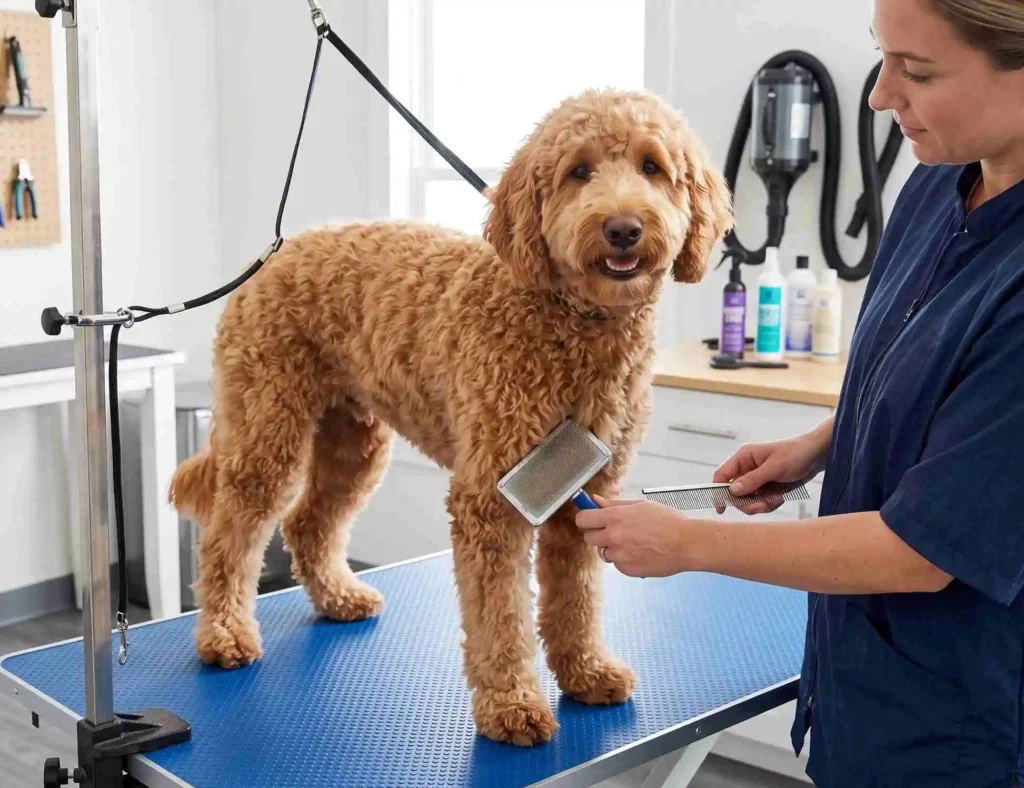
Table of Contents
Why Goldendoodle Grooming Matters More Than You Think
Goldendoodle coat care isn’t cosmetic. Tight mats pull constantly on the skin, restrict blood flow, and trap moisture underneath. That warm, damp pocket becomes an ideal environment for bacterial and yeast infections. Owners often discover raw, inflamed skin only after a groomer shaves a matted area down.
Severe matting also limits what a groomer can do. When the coat is felted to the skin, a short shave-down is the only humane option — clipping through mats risks cutting skin. Many owners are surprised and upset by this, but it reflects welfare, not laziness.
There’s a comfort side too. A dog wearing a matted coat can’t cool efficiently, can’t stretch normally, and often becomes touch-sensitive. Dogs who dislike grooming frequently learned that lesson through painful de-matting sessions.
The good news: consistent maintenance prevents nearly all of this. Fifteen focused minutes, a few times a week, beats a two-hour emergency de-matting session every time.
Understanding the Goldendoodle Coat
Goldendoodles inherit a mix of Golden Retriever and Poodle genetics, and that mix produces three broad coat types.
Straight or flat coats look closest to a Golden Retriever. They shed more, mat less, and need the least maintenance.
Wavy or fleece coats are the most common. They have soft, loose waves, shed lightly, and tangle at friction points.
Curly coats are Poodle-dominant. They shed very little, trap loose hair inside the curl, and mat fastest. These dogs need the most work.
The key point is that Doodle hair grows continuously rather than shedding out on a cycle. Loose hair that would normally fall off a Labrador stays woven into a Goldendoodle’s coat, gradually knitting into mats. That’s why low-shedding breeds are higher maintenance, not lower — a trade-off many owners exploring large low-shedding breeds don’t hear about upfront.
Where Mats Form First
Friction and moisture create mats. Check these zones every single session:
- Behind and inside the ears
- Armpits and chest
- Between the back legs and around the sanitary area
- The collar line
- Between the toes and pads
- The tail base
The Coat Change
Between roughly 8 and 14 months, most Goldendoodles go through a coat change as the adult coat replaces the puppy coat. Matting explodes during this period. Many owners think they’re doing something wrong — they aren’t. Increase brushing to daily and shorten the trim length until it passes. Owners of the smaller varieties will notice the same phase; the mini Goldendoodle care timeline follows the same pattern on a smaller frame.
Common Grooming Mistakes (And How to Fix Them)
Mistake 1: Brushing only the top layer. The coat looks smooth while mats form underneath, undetected. The fix: Line-brush. Part the coat with one hand and brush from the skin outward in horizontal sections.
Mistake 2: Skipping the comb. A slicker brush glides over mats without catching them. The fix: Follow every brushed section with a metal comb. The comb is the test; the brush is the tool.
Mistake 3: Bathing before brushing. Water shrinks and tightens existing tangles into solid felt. The fix: Brush and comb the entire dog out first. No exceptions.
Mistake 4: Letting the coat air-dry. Curls contract as they dry, locking tangles in place. The fix: Blow-dry on cool or low heat while brushing the coat straight.
Mistake 5: Stretching appointments to 12+ weeks. The coat outgrows what maintenance brushing can handle. The fix: Book the next appointment before leaving the salon.
Mistake 6: Ignoring the ears. Goldendoodles have floppy ears and hair inside the canal, trapping moisture. The fix: Check and clean ears weekly, especially after swimming or bathing.
Mistake 7: Forcing a fearful dog through a long session. One painful session can create years of grooming anxiety. The fix: Keep sessions short and positive. Stop while the dog is still relaxed.
The Tools That Actually Change the Outcome
Most at-home grooming failures trace back to equipment, not effort. A cheap slicker brush with soft, bending pins skims the coat surface and never reaches the skin — which is exactly where Goldendoodle mats live. Owners brush faithfully for weeks, then get told at the salon that their dog needs a shave-down. The tool, not the owner, was the problem.
The other common gap is trimming. Even with a professional on the calendar, coat grows over the eyes, around the sanitary area, and between the paw pads long before the next appointment. Human scissors and standard clippers stall out and pull on a dense Doodle coat, which teaches the dog that grooming hurts.
For maintenance clipping between appointments, the oneisall Dog Clippers for Grooming are built for exactly this coat type. They’re designed for thick, heavy coats, run cordless and rechargeable, and use a stainless steel blade that keeps cutting instead of bogging down in dense fleece. The low-noise motor genuinely matters with an anxious dog — a screaming clipper is often what makes a Doodle fear grooming in the first place. They’re best suited to touch-ups: face, feet, sanitary areas, and light body trims. The honest limitation is that these aren’t full-salon-grade clippers. If you attempt a complete body clip on a heavily matted dog, the blade will heat up and you’ll need to work in stages with breaks.
CHECK PRICE ON AMAZON: https://amzn.to/40agbz9
Nails are the other job owners routinely put off. Goldendoodle nails grow fast, and long nails change how a dog stands, putting strain on the toe joints. Many Doodles hate the pinch-and-crack sensation of clippers, which turns nail day into a wrestling match.
A grinder solves the sensation problem. The Dremel PawControl 7760-PET Dog Nail Grinder files nails down gradually rather than cutting them, which makes it far easier to stop short of the quick — a real advantage on dark nails where you can’t see the blood supply. It’s cordless and rechargeable, so there’s no cord to manage around a squirming dog. The limitation is time: grinding takes noticeably longer than clipping, and dogs need a proper introduction to the vibration and hum before they’ll tolerate it. Start by simply letting the dog hear it running near a treat, days before you touch a paw. For dogs who prefer a fast snip instead, our guide to choosing dog nail clippers walks through the alternatives.
CHECK PRICE ON AMAZON: https://amzn.to/4rl079X
Long grooming sessions also test a dog’s patience. A LUKITO Lick Mat suction-cupped to the tub wall or a counter gives your Goldendoodle something absorbing to do while you work. Spread it with peanut butter or wet food and the licking motion itself has a calming, self-soothing effect. It’s most useful for bath time, blow-drying, and nail work — the three tasks dogs resist most. The limitation is duration: a thin smear lasts about five minutes, so freeze it beforehand if you need it to hold attention longer.
CHECK PRICE ON AMAZON: https://amzn.to/4aQdOHT
Step-by-Step: How to Groom a Goldendoodle at Home
- Set up first. Non-slip surface, good light, and everything in reach — slicker brush, metal comb, clippers, treats. A dog who watches you leave to find scissors learns that grooming is unpredictable.
- Do a full mat check. Run your hands over every friction zone listed earlier. Find the problems before you start, not halfway through.
- Line-brush the whole coat. Start at the lowest point of a leg. Part the hair horizontally with one hand, brush the exposed section from the skin outward, then move the part up an inch. Work leg by leg, then body, then chest and neck.
- Comb-test every section. Run the metal comb through. If it snags, that area isn’t finished. Return to it.
- Work small mats out gently. Hold the hair at the base — between the mat and the skin — so you aren’t pulling the skin itself. Tease the mat apart with your fingers, then work the comb from the outer edge inward. If it doesn’t loosen in a couple of minutes, leave it for the groomer.
- Trim the practical spots. Face hair above the eyes, sanitary area, and hair between the paw pads. Work with the clipper flat against the skin and go slowly.
- Bathe only after the coat combs clean. Lukewarm water, dog-specific shampoo, and thorough rinsing. Leftover product residue is a common cause of itching.
- Blow-dry while brushing. Cool or low heat, held a few inches away, brushing the coat straight as it dries. This step is what produces the fluffy Doodle look — and what prevents the next round of mats.
- Clean the ears. Apply a vet-recommended cleaner, massage the base, let the dog shake, then wipe the visible part with cotton. Never push anything into the canal.
- Handle nails last. Grind or clip small amounts, praise generously, and end the session on a good note.
Keep the whole routine to 20–30 minutes for maintenance sessions. Split it across two days if your dog gets restless.
Troubleshooting: If This, Then That
- If the comb catches but the brush doesn’t — that section still has tangles. Re-brush it from the skin.
- If a mat won’t loosen after two minutes — stop. Book the groomer instead of causing pain.
- If your dog pulls the paw away every time — you’re likely too close to the quick or holding too tightly. Shorten sessions to one nail per day.
- If the coat frizzes instead of fluffing after drying — you air-dried too long or didn’t brush during drying.
- If the skin looks red or flaky after grooming — check for shampoo residue and rinse more thoroughly next time.
- If your dog scratches at the ears repeatedly — stop cleaning and have a vet check for infection.
- If matting suddenly worsens around 10 months — that’s the coat change. Increase brushing frequency and shorten the trim.
- If your dog panics at the clipper sound — reintroduce it turned on but not touching, paired with treats, over several short sessions.
When to Call a Professional
Book a groomer or vet rather than pushing through if you see:
- Mats that feel tight and flat against the skin across large areas
- Red, weeping, or foul-smelling skin under a mat
- A dark discharge or strong odor from the ears
- Bleeding after a nail trim that won’t stop within a few minutes
- Persistent scratching, chewing, or hair loss in patches
- A dog who growls, snaps, or panics during handling
Heavily matted coats need professional equipment and judgment. There’s no shame in a shave-down — it’s a reset, and the coat grows back.
Expert Perspective
The American Kennel Club emphasizes that regular brushing does more than keep a dog looking tidy: it distributes natural skin oils through the coat, removes dead hair and debris, and gives owners a routine opportunity to spot lumps, parasites, or skin changes early. For a continuously growing coat like a Goldendoodle’s, that early-detection benefit is significant, because problems hide beneath several inches of fur. You can review the AKC’s general dog grooming guidance for breed-wide fundamentals.
Veterinarians consistently link chronic matting to secondary skin disease, and the American Veterinary Medical Association’s pet care resources reinforce that routine at-home care and prompt veterinary attention for skin problems go hand in hand. If you notice inflammation, odor, or a dog obsessively licking one area, treat it as a medical question rather than a grooming one — hot spots in dogs develop quickly under damp, matted fur.
This article offers general grooming and care information. It is not a veterinary diagnosis. Always consult your own veterinarian about your dog’s specific health concerns.
Frequently Asked Questions
How often should I groom a Goldendoodle? Brush 3–4 times weekly at minimum, and daily for curly coats or during the coat change. Bathe every 4–6 weeks. Schedule professional grooming every 6–8 weeks for clipping and trimming.
Can I groom a Goldendoodle myself? Yes, for maintenance. Brushing, combing, bathing, drying, nail care, and light face and paw trimming are all manageable at home. Full body clips and heavy de-matting are better left to professionals.
What is line brushing? Line brushing means parting the coat horizontally and brushing each exposed section from the skin outward before moving up an inch. It reaches the undercoat where mats form, which surface brushing misses entirely.
Why does my Goldendoodle mat so quickly? Goldendoodle hair grows continuously instead of shedding out. Loose hair stays trapped in the coat and knits into mats, especially at friction points like armpits, ears, and the collar line.
Should I shave my Goldendoodle in summer? A short trim is fine and often practical. A full shave removes the coat’s insulation against heat and sun exposure, so discuss length with your groomer rather than shaving to the skin.
At what age should Goldendoodle grooming start? Start handling paws, ears, and coat at 8–10 weeks. Book the first professional appointment around 12–16 weeks, mainly to build a positive association rather than to remove much hair.
How long does grooming a Goldendoodle take? Home maintenance sessions run 20–30 minutes. A full professional groom typically takes 2–3 hours, longer if de-matting is required.
Is it normal for grooming to be uncomfortable? Routine brushing should never hurt. Discomfort usually means mats are pulling at the skin or the brush is being pressed too hard. Adjust technique and check for tight tangles.
What happens during the coat change? Between 8 and 14 months, the adult coat replaces the puppy coat and matting increases sharply. Brush daily and keep the trim short until the transition finishes.
Do Goldendoodles need their ears cleaned? Yes. Floppy ears with hair inside trap moisture. Check weekly and clean with a vet-recommended solution, especially after swimming or bathing. See a vet for odor or discharge.
Bringing It All Together
Learning how to groom a Goldendoodle comes down to one shift in thinking: you’re preventing mats, not fixing them. The owners who find grooming easy aren’t working harder — they’re brushing to the skin, testing with a comb, and drying properly every time. Everything else follows from those three habits. Keep sessions short, keep them positive, and stop before your dog gets restless. Your groomer will notice the difference, and so will your dog. Pick one afternoon this week, part the coat behind an elbow, and see what’s actually going on under there — that single check tells you exactly where to start.