Picture this: it’s your first night home with your new puppy. You put them in the crate, turn off the light — and then it starts. The whining, the scratching, the heartbreaking little cries. If you’re wondering how to crate train a puppy without the drama, you are absolutely not alone. Millions of new dog owners face this exact moment and aren’t sure what to do next. The good news? Crate training done right is one of the best gifts you can give your pup.
Quick Answer
Crate training a puppy means teaching them to see their crate as a safe, comfortable den — not a punishment. It reduces anxiety, prevents destructive behavior, and speeds up potty training by using a dog’s natural instinct to keep their sleeping space clean. This approach works for puppies of all breeds and is recommended by veterinarians and professional trainers alike.
TL;DR: Start small, go slow, and always make the crate a positive place. Never use it for punishment. With patience and consistency, most puppies accept the crate within 1–2 weeks.
Key Takeaways
- Introduce the crate gradually — never force your puppy inside
- Keep early sessions short (5–10 minutes) and always reward calm behavior
- Cover the crate with a blanket to create a cozy, den-like feel
- Puppies under 12 weeks should not be crated for more than 1–2 hours at a time
- A consistent schedule is the single most important factor in crate training success
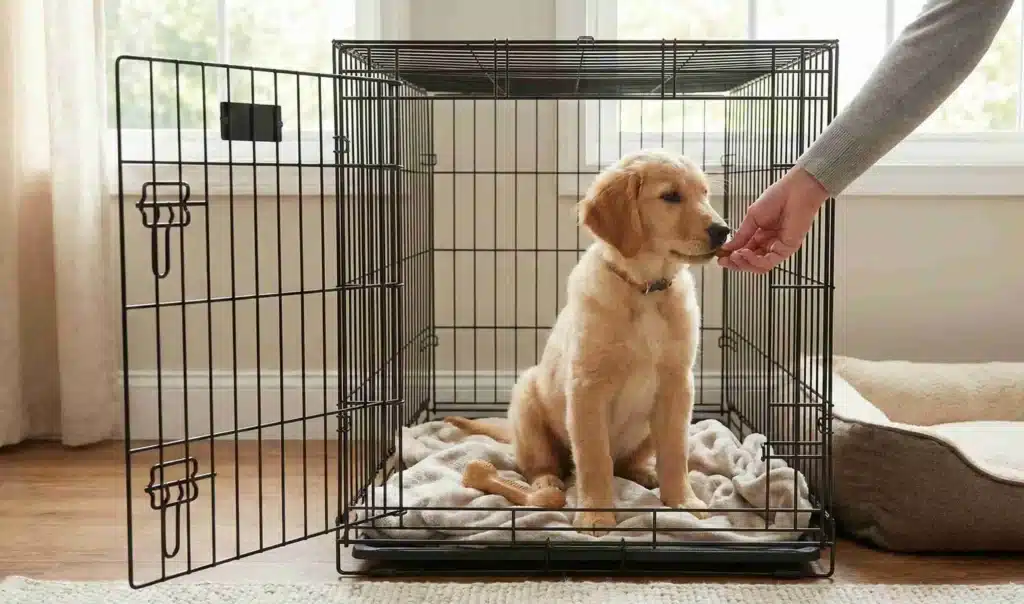
Table of Contents
Why Crate Training Matters for Your Puppy’s Health and Wellbeing
Crate training is about so much more than keeping your sofa safe. According to the American Kennel Club (AKC), dogs are den animals by nature. A crate mimics that instinct perfectly — giving your puppy a quiet, private space where they can rest and decompress.
Without structure and a safe space, puppies often develop anxiety, destructive chewing habits, or potty training problems that can persist into adulthood. A crate-trained dog is also far easier to manage at the vet, during travel, or in an emergency. Think of the crate as your puppy’s bedroom: a place that belongs entirely to them.
Done correctly, crate training reduces separation anxiety over time. Done incorrectly — by rushing, punishing, or confining too long — it creates exactly the opposite effect. This guide will help you do it right.
The Anatomy of Crate Training: How It Actually Works
Crate training is built on one core principle: classical conditioning. You’re pairing the crate (a neutral object) with things your puppy already loves — treats, meals, cozy bedding, calm praise — until the crate itself becomes a source of comfort.
Dogs naturally avoid soiling where they sleep. This instinct is your biggest ally during potty training. When your puppy is in a properly sized crate, they’ll hold their bladder longer because they don’t want to soil their sleeping space. This makes crating during the night or short daytime stretches a powerful potty training tool.
The key word here is “properly sized.” A crate that’s too large defeats the purpose — your puppy will just use one corner as a bathroom. A crate that’s too small causes stress. Most crates come with a divider panel so you can adjust the space as your puppy grows, which makes life a lot easier.
Common Crate Training Mistakes (and Fixes)
Even well-meaning owners make these errors. Watch out for every single one:
- Using the crate as punishment. The fix: Never send your puppy to the crate when you’re angry. The crate must always be associated with good things.
- Leaving the puppy in too long. The fix: Follow the “one hour per month of age” rule for daytime crating, plus one. A 2-month-old puppy should max out at 3 hours.
- Skipping the introduction phase. The fix: Let your puppy explore the crate on their own terms with the door open before you ever close it.
- Giving in to whining immediately. The fix: Wait for a pause in crying before opening the door. If you open it mid-cry, you teach them that whining works.
- Choosing the wrong crate size. The fix: The crate should be just large enough for your puppy to stand, turn around, and lie down comfortably — nothing more.
- Placing the crate in an isolated spot. The fix: Put the crate where your family spends time. Puppies are social; isolation increases stress.
- No crate-time routine. The fix: Use consistent cues like “crate” or “bed” every single time. Predictability is calming for dogs.
Solving the Biggest First Problem: An Anxious Puppy at Night
One of the hardest parts of crate training is the first few nights. Your puppy has just left their littermates — the only world they’ve ever known. Warmth, heartbeat sounds, and familiar smells make a huge difference in those early days.
This is exactly why a heartbeat comfort toy can be a game-changer during the initial crate training phase. Many trainers recommend them as a way to ease the transition without creating dependency on human presence.
The Original Snuggle Puppy Heartbeat Puppy Toy is purpose-built for this situation. It replicates the feel of a littermate: a soft plush body with a battery-powered heartbeat inside. You can also tuck in a heat pack for added warmth. Trainers and shelters have used this toy for years to reduce nighttime crying and help puppies settle faster. It’s especially useful during the first 1–3 weeks when the crate is brand new and your puppy hasn’t yet associated it with safety. One honest note: the batteries do need replacing periodically, and some dogs chew through the toy if left unsupervised — so save it for crate time only.
CHECK PRICE ON AMAZON: https://amzn.to/4kCZCoX
Choosing the Right Crate: What You Actually Need
Before you can train a puppy, you need the right crate. Wire crates are the most versatile option for most owners because they offer ventilation, visibility, and adjustable sizing. If you’re wondering which travel crate to use for trips, that’s a separate consideration — but for home training, a wire crate with a divider panel is the gold standard.
The MidWest Homes for Pets 24-Inch iCrate is one of the most widely recommended wire crates for puppies, and for good reason. It comes with a divider panel so you can expand the space as your puppy grows, a leak-proof tray for accidents, and secure double latches that keep curious pups safely inside. It folds flat for storage and sets up in seconds — no tools required. It’s ideal for small to medium breeds during the crate training phase. The main limitation is that heavy chewers may bend the wire over time, so it works best for puppies rather than adult power chewers.
CHECK PRICE ON AMAZON: https://amzn.to/4ripwkq
Step-by-Step Crate Training Tutorial
Follow these steps in order. Rushing ahead will cost you time in the long run.
Step 1: Set up the crate in a social area. Place it in your living room or bedroom — somewhere your family spends time. Line it with a soft blanket and drop a few treats inside. Leave the door open and let your puppy wander in and out freely. Do this for a day before any structured training.
Step 2: Feed meals near the crate. Start by placing the food bowl just outside the crate door. Over the next few meals, move it progressively inside: first at the entrance, then just inside, then at the back. This builds a positive association without any pressure.
Step 3: Begin short, door-closed sessions. Once your puppy walks in calmly for meals, close the door while they eat. Open it as soon as they finish. Gradually extend this: close it for 5 minutes while they chew a treat, then 10, then 20. Always stay nearby so they can see you.
Step 4: Introduce a cue word. Every time your puppy goes in, say “crate” or “bed” in a calm, cheerful tone and reward with a treat. This word becomes a signal that great things are about to happen.
Step 5: Practice “crate time” during the day. Build up to 30-minute stretches during the day while you’re home. Leave a Kong toy stuffed with peanut butter or kibble to keep them occupied. A puppy that’s calm and busy in the crate during the day will be calmer at night too.
Step 6: Begin nighttime crating. Move the crate into your bedroom for the first few weeks. Your presence reduces anxiety significantly. Set an alarm every 3–4 hours for a puppy bathroom break. Over time, as bladder control improves, nighttime wake-ups will decrease naturally.
Step 7: Gradually extend alone time. Once your puppy is comfortable with 30-minute stretches with you home, begin short departures. Leave calmly, return calmly. Don’t make arrivals or departures a big event — that amplifies anxiety on both ends.
If your puppy is already whining in the crate regularly, that guide walks you through targeted solutions for nighttime crying and how to distinguish normal adjustment from genuine distress.
Troubleshooting: If/Then Scenarios
- If your puppy whines immediately after you close the door → You moved too fast. Go back to open-door feeding and shorter closed-door sessions.
- If your puppy has accidents in the crate → The crate is likely too large. Use the divider panel to reduce the space, or you may be crating too long.
- If your puppy refuses to enter the crate at all → Slow down and increase the value of treats. Try high-value rewards like small pieces of chicken or cheese — yes, dogs can eat cheese in small amounts as a training reward.
- If your puppy cries all night, every night, for more than a week → Try moving the crate to your bedroom, adding a heartbeat toy, and ensuring your puppy gets enough exercise and play before bedtime.
- If crate training seems to increase anxiety over time → This may indicate separation anxiety rather than a training issue. Consult your vet or a certified trainer for a behavior modification plan.
When to See a Professional
Crate training is typically straightforward, but there are real red flags that warrant a call to your vet or a certified dog trainer:
- Extreme panic responses: excessive drooling, vomiting, or injuring themselves trying to escape
- Whining and distress that doesn’t improve at all after 2–3 weeks of consistent training
- Aggressive behavior when approached while in the crate
- Regression in a previously crate-trained dog combined with other behavior changes
These signs may point to anxiety disorders, a medical issue, or early trauma that needs professional support. The information in this article is general guidance for healthy puppies — it is not a substitute for veterinary advice.
Expert Opinion: What Professionals Say About Crate Training
Veterinary behaviorists consistently support crate training as a humane and effective management tool when used correctly. The American Veterinary Medical Association (AVMA) notes that confinement training, done gradually and positively, supports a dog’s psychological wellbeing by providing predictability and security.
Certified professional dog trainers emphasize that the most common reason crate training fails is impatience. Most people try to rush the acclimation phase — skipping open-door exploration and jumping straight to long confinement. Research in animal behavior consistently shows that gradual desensitization produces more durable behavior change than forced exposure. A puppy that learns to love their crate through positive reinforcement will use it voluntarily well into adulthood — many dogs retreat to their crates on their own when they need rest or quiet time.
If your puppy is also showing behavior problems beyond crate training, a certified trainer can help you build a comprehensive training plan that covers everything from biting to leash manners.
Frequently Asked Questions
How long does it take to crate train a puppy? Most puppies adjust within 1–2 weeks with consistent daily training. Some take up to a month, especially if they had a difficult start. Patience and consistency matter more than speed.
Can I crate train a puppy at night right away? Yes, but start with the crate in your bedroom so they can sense your presence. Expect wake-ups every 3–4 hours for bathroom breaks for the first few months.
How long can a puppy stay in a crate? A general rule is one hour per month of age plus one. A 2-month-old puppy can handle about 3 hours maximum. Never exceed 4–5 hours for young puppies during the day.
Should I put water in the crate? For short stays, water inside the crate isn’t necessary and can increase accidents. For longer periods over 4 hours, attach a crate-safe water bottle to the side.
Is it okay to let my puppy cry it out in the crate? Not entirely. You should wait for a brief pause before opening the door so you’re not rewarding whining. But prolonged distress isn’t beneficial — if your puppy is truly panicking, reassess your training pace.
What do I put in a puppy crate at night? A soft blanket, a worn T-shirt with your scent, and a heartbeat toy work well. Avoid loose items your puppy could chew and swallow.
Is crate training cruel? No — when done correctly, crate training is humane and psychologically beneficial. Dogs are naturally drawn to enclosed, den-like spaces. The key is association: the crate must always be connected to positive experiences, never punishment.
What size crate does a puppy need? Your puppy should be able to stand, turn around, and lie down flat — nothing bigger. Most owners buy an adult-sized crate with a divider panel to grow into it.
When can I stop using the crate? Most owners phase it out between 1–2 years when the dog is fully reliable with house manners. Many dogs continue using it voluntarily as adults.
My puppy was doing well, then suddenly started hating the crate — why? Regressions often happen during fear periods (around 8 and 16 weeks), after illness, or after a schedule change. Return to basics, shorten sessions, and rebuild positive associations.
Conclusion
Learning how to crate train a puppy is one of the most impactful things you can do for your dog’s long-term wellbeing and your own peace of mind. It’s not about restriction — it’s about giving your puppy a safe, predictable space in a world that’s still very new and overwhelming. Go slowly, keep every interaction with the crate positive, and resist the urge to rush ahead when things seem to be going well. The groundwork you lay in the first few weeks will shape your dog’s relationship with their crate for years to come. Start tonight with something small: toss a treat inside the crate, let your puppy walk in on their own terms, and celebrate that tiny win. The journey of a thousand miles begins with a single step — or in this case, a single treat tossed through an open crate door.